
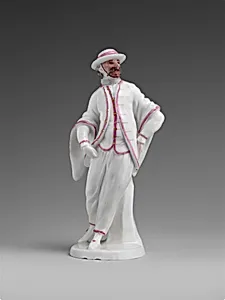
Masquerader
Medium
Soft-paste porcelain
Dimensions
Height: 6 in. (15.2 cm)
Classification
Ceramics-Porcelain
Culture
Swiss, Zurich
Department
European Sculpture and Decorative Arts
Museum
Metropolitan Museum of Art, New York, NY
Credit
Gift of R. Thornton Wilson, in memory of Florence Ellsworth Wilson, 1950
Accession Number
50.211.265
Rights
Public Domain
Tags
Art Historical Context
Step into the whimsical world of 18th Swiss porcelain with *Masquerader*, a figurine crafted by the Zurich Pottery and Porcelain around 1765–70. Standing just 6 inches tall, this soft-paste porcelain captures a mysterious reveler in mid-performance, evoking the lively spirit of European masquerades. The "Men" tag hints at its depiction of a male figure, donning an elaborate costume that reflects the era's fascination with disguise and festivity. Zurich emerged as a key player in Europe's porcelain scene during the Rococo period, with its factory pioneering soft-paste porcelain—a refined, translucent material blending clay, glass frit, and other ingredients, fired at lower temperatures than true hard-paste. This technique allowed for intricate modeling and vibrant overglaze colors, making pieces like this affordable luxury for the elite. Produced in the Swiss city of Zurich, it showcases the region's technical innovation amid competition from Meissen and Sèvres. Housed in the Metropolitan Museum of Art's European Sculpture and Decorative Arts department (gift of R. Thornton Wilson, 1950), *Masquerader* embodies cultural joie de vivre—think Venetian carnivals and commedia dell'arte—serving as both tabletop ornament and a snapshot of Enlightenment-era social play. Its enduring charm invites us to ponder the hidden identities behind every mask.