
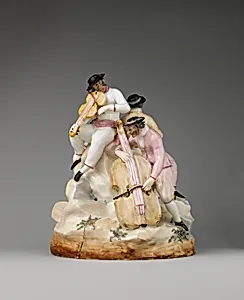
Four Carnival Musicians
Medium
Soft-paste porcelain
Dimensions
Overall (confirmed): 8 1/4 × 6 3/4 × 6 15/16 in. (21 × 17.1 × 17.6 cm)
Classification
Ceramics-Porcelain
Culture
Swiss, Zurich
Department
European Sculpture and Decorative Arts
Museum
Metropolitan Museum of Art, New York, NY
Credit
Gift of Douglas Dillon, 1982
Accession Number
1982.450.16
Rights
Public Domain
Tags
Art Historical Context
This charming soft-paste porcelain group, created around 1770 at the Zurich Pottery and Porcelain Factory, captures four lively musicians in festive carnival attire. Modelled by Joseph Nees, the figures are shown playing violins and cellos, their animated poses and expressive faces conveying the joy of a street performance. Standing just over eight inches tall, the sculpture was designed as an elegant tabletop ornament, reflecting the period’s taste for small-scale decorative works that brought music and merriment into domestic settings. In eighteenth-century Europe, carnival celebrations offered a rare moment when social hierarchies relaxed, and music played a central role in the revelry. Swiss porcelain factories like Zurich competed with Meissen and other German centers by producing finely modelled figures that combined Rococo playfulness with local craftsmanship. The soft-paste material allowed for delicate detailing in the musicians’ clothing and instruments, while the subtle painted colors enhanced their theatrical appearance. Today, *Four Carnival Musicians* offers visitors a vivid glimpse into the cultural importance of music and festivity in Enlightenment-era society. Its presence in the Metropolitan Museum’s collection of European decorative arts highlights how such porcelain groups served not only as luxury objects but also as lasting records of popular entertainment traditions.