
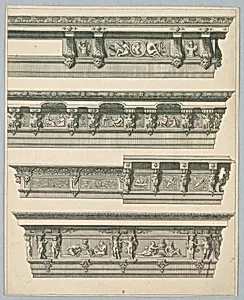
Four Cornice Designs
17th century
Classification
Department
Smithsonian Collection
Museum
Smithsonian American Art Museum
Credit
Gift of Eleanor and Sarah Hewitt
Accession Number
1931-94-658
Rights
Public Domain
About this artwork
Research in Progress
Art Historical Context
Nestled in the Smithsonian American Art Museum's collection *Four Cornice Designs* offers a glimpse into 17th-century architectural ornamentation. Created by an unknown artist during an era of lavish Baroque and Renaissance influences, this print showcases intricate patterns for cornices—those elegant, projecting moldings that crown doors, windows, and walls in grand buildings. As a print, it exemplifies how such designs were disseminated widely, allowing architects, builders, and artisans across Europe and the American colonies to replicate sophisticated motifs without direct access to originals. The medium, though unspecified, underscores the print's role as a practical tool in the decorative arts. In the 17th century, printed pattern books revolutionized design by standardizing styles and fostering innovation amid booming construction in churches, palaces, and homes. These cornice designs likely drew from classical motifs like acanthus leaves or scrolls, blending functionality with artistry to elevate everyday architecture. Generously gifted by collectors Eleanor and Sarah Hewitt, renowned for their passion for design history, this work awaits further research. It invites visitors to ponder the unseen hands behind the opulent buildings that shaped our world, bridging the gap between blueprint and built legacy.
About the Artist
Unknown
The artist designated as "Unknown" in our virtual museum's collection exemplifies a poignant chapter in art history: creators whose identities have faded into obscurity despite the enduring power of their work. With only one known artwork attributed to them in our holdings, this figure represents countless anonymous hands that shaped visual culture across centuries. Museums worldwide, including th...