
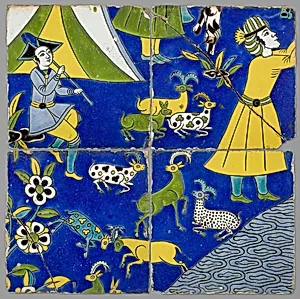
Four Tiles with a Figural Scene
Safavid dynasty (1501–1722), 17th century
Medium
Fritware with polychrom overglaze decoration
Dimensions
Each: 24.2 × 24.2 × 2.2 cm (9 1/2 × 9 1/2 × 7/8 in.)
Classification
earthenware
Department
Arts of Asia
Museum
Art Institute of Chicago
Accession Number
137226
Rights
Public Domain
About this artwork
The practice of decorating tiles with bright colors outlined in black was known as cuerda seca, which translates as “dry cord” from Spanish. Cuerda seca developed in the Islamic lands of Spain, Iran, and Central Asia at the end of the 14th century and remained popular in these regions for several centuries. The black line between colors allowed for carefully distinguished forms that otherwise might have been muddles during the firing process.These tiles are a section of a larger scene depicting ...
About the Artist
Islamic
Islamic art, a profound visual tradition originating in the 7th century CE, flourished across vast territories from Spain to India under Muslim rule, encompassing architecture, ceramics, manuscripts, textiles, and metalwork produced by diverse artisans rather than a single named master. Drawing from pre-Islamic Sasanian, Byzantine, and late antique influences, its early development under the Umayy...