
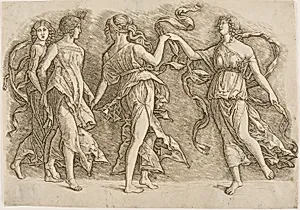
Four Women Dancing
c. 1497
Medium
Engraving on paper
Dimensions
23.8 × 33.6 cm (9 3/8 × 13 1/4 in.)
Classification
engraving
Department
Prints and Drawings
Museum
Art Institute of Chicago
Accession Number
4316
Rights
Public Domain
About this artwork
This print was created by an unidentified engraver, who worked in the circle around Andrea Mantegna and was responsible for a group of engravings based on the artist's drawings. The composition is derived from Mantegna's preparatory drawing for the four central dancing muses in a painting for the Studiolo of Isabella d'Este, the young wife of Francesco Gonzaga of Mantua.
Art Historical Context
Andrea Mantegna's *Four Women Dancing*, created around 1497, is a engraving on paper measuring 23.8 × 33.6 cm, housed in the Art Institute of's Prints and Drawings Department. As one of the leading Italian artists of the Early Renaissance,antegna was renowned for his innovative use of perspective and classical motifs, bridging antiquity with contemporary humanism. This work exemplifies his mastery in translating dynamic movement into precise lines, likely depicting joyful female figures in a bacchanalian revelry inspired by ancient Roman frescoes. Engraving, Mantegna's preferred medium here, involved incising intricate designs into a copper plate with a burin, then printing onto paper—a technique he helped pioneer in Italy during the late 15th century. Unlike paintings, engravings allowed for multiple impressions, democratizing access to high art beyond elite patrons and influencing northern European printmakers like Dürer. The rhythmic poses and flowing drapery showcase Mantegna's sculptural approach, evoking the vibrant energy of Renaissance festivals. This piece offers a window into the era's fascination with classical mythology and the female form, blending technical virtuosity with cultural exuberance. Visitors will appreciate its enduring appeal as both a technical marvel and a lively snapshot of Renaissance imagination.
About the Artist
Andrea Mantegna · 1431–1506
Andrea Mantegna was born around 1431 near Padua, in the Venetian Republic, the son of a carpenter. At approximately age eleven he was taken into the workshop of the Paduan painter and antiquities collector Francesco Squarcione, who enrolled him as a guild member and immersed him in the study of Roman sculpture and classical Latin. Though Mantegna later claimed that Squarcione had exploited his lab...