
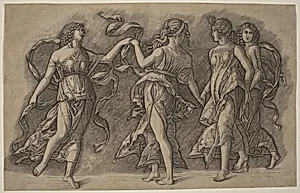
Four Dancing Muses
Medium
engraving on laid paper
Classification
Department
CG-E
Museum
National Gallery of Art, Washington, D.C.
Credit
Print Purchase Fund (Rosenwald Collection)
Accession Number
1975.53.2
Rights
Public Domain
Art Historical Context
**Four Dancing Muses** is a delicate engraving created around 1500–1505 by Giovanni Antonio da Brescia a skilled Italian printmaker, faithfully reproducing a composition by the renowned Renaissance master Andrea Mantegna. Mantegna, a pioneer of the early Renaissance in northern Italy, drew inspiration from classical antiquity, infusing his works with precise perspective, graceful figures, and a sense of movement. Here, the four muses—embodiments of artistic inspiration—dance in rhythmic unity, their flowing drapery and poised gestures evoking the joy of poetry, music, and dance from Greek mythology. This print exemplifies the Renaissance fascination with humanist ideals, bridging ancient Roman frescoes and sculptures with modern artistry. Da Brescia's meticulous engraving technique captures Mantegna's intricate details, from the muses' expressive faces to the subtle textures of their garments, making high art accessible beyond elite patrons. Engravings on laid paper like this one revolutionized art dissemination, allowing collectors across Europe to own affordable replicas that influenced artists and scholars alike. Housed in the National Gallery of Art's Rosenwald Collection, acquired through the Print Purchase Fund, this work highlights printmaking's role in preserving and popularizing Renaissance genius. Visitors are invited to marvel at how these dancing figures still inspire a celebration of creativity today. (198 words)