
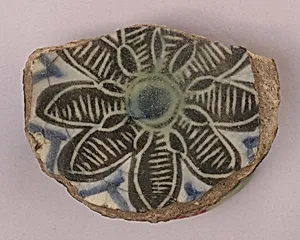
Fragment
Unknown Artist
13th–16th century
Medium
Stonepaste; painted under transparent glaze
Dimensions
H. 1 1/16 in. (2.7 cm) W. 3 in. (7.6 cm) D. 2 7/16 in. (6.2 cm) Wt. 2.2 oz. (62.376 g)
Classification
Ceramics
Department
Islamic Art
Museum
Metropolitan Museum of Art, New York, NY
Credit
Gift of Jack A. Josephson, 1973
Accession Number
1973.79.46
Rights
Public Domain
Art Historical Context
This delicate ceramic fragment, hailing from the Islamic world between the 13th and 16th centuries, offers a glimpse into the golden age of medieval Islamic artistry. Crafted from stonepaste—a sophisticated composite of quartz, white clay, and glass frit—this small piece (just over 3 inches wide) exemplifies the ingenuity of potters in regions like Iran, Syria or Egypt. Stonepaste bodies allowed for thinner walls and brighter glazes than traditional earthenware, enabling artisans to rival Chinese porcelain in translucency and refinement. Painted under a transparent glaze, the fragment likely once formed part of a larger decorative ensemble, such as a tile panel adorning a mosque, palace, or mihrab. This underglaze technique, popular during the Ilkhanid, Timurid, and early Safavid periods, permitted vibrant colors and intricate motifs to shine through the glossy surface, resisting wear from daily use or environmental exposure. Such ceramics were not merely functional but symbols of cultural prestige, blending technical mastery with aesthetic elegance. Though its exact design is fragmented, this artifact underscores the Islamic world's pivotal role in ceramic innovation, influencing global traditions. Donated to the Metropolitan Museum of Art in 1973 by Jack A. Josephson, it invites us to ponder the hands that shaped it centuries ago.