
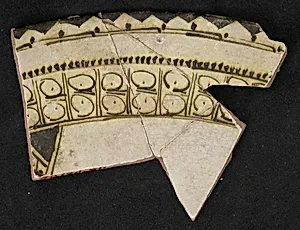
Fragment of a Bowl
Unknown Artist
9th–10th century
Medium
Earthenware; reddish body, white slip with yellow black decoration under transparent glaze
Dimensions
H. 6 1/4 in. (15.8 cm) W. 4 in. (10.2 cm)
Classification
Ceramics
Department
Islamic Art
Museum
Metropolitan Museum of Art, New York, NY
Credit
Rogers Fund, 1940
Accession Number
40.170.511
Rights
Public Domain
Art Historical Context
This delicate fragment of a bowl, dating to the 9th–10th century, offers a glimpse into the vibrant ceramic traditions of the Islamic world during the Abbasid era. Crafted from earthenware with a characteristic reddish body, it exemplifies early advancements in pottery production across regions like Iraq and Persia. Though only a portion survives—measuring 6¼ inches high and 4 inches wide—it hints at the elegant, functional vessels that graced dining tables and households of the time. The artwork's medium is particularly noteworthy: a white slip (a liquid clay coating) forms the base for yellow-black decoration, all sealed under a transparent glaze. This slip-painting technique allowed artisans to create intricate designs with vibrant contrasts, marking a sophisticated evolution from earlier unglazed wares. The transparent glaze not only protected the surface but also enhanced the luster, reflecting the Islamic emphasis on beauty in everyday objects. Housed in the Metropolitan Museum of Art's Islamic Art Department (acquired via the Rogers Fund in 1940), this piece underscores the cultural flourishing of the period, where ceramics became a canvas for innovation and trade. Visitors can appreciate how such fragments preserve the ingenuity of anonymous masters, bridging ancient craftsmanship with our modern gaze.