
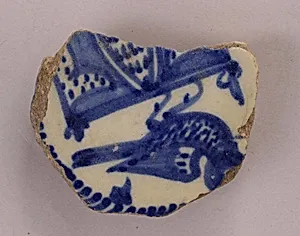
Fragment of a Bowl or Cup
Unknown Artist
13th–16th century
Medium
Stonepaste; painted under transparent glaze
Dimensions
H. 5/8 in. (1.6 cm) W. 2 9/16 in. (6.5 cm) D. 2 5/16 in. (5.9 cm) Wt. 1.2 oz. (34.023 g)
Classification
Ceramics
Department
Islamic Art
Museum
Metropolitan Museum of Art, New York, NY
Credit
Gift of Jack A. Josephson, 1973
Accession Number
1973.79.10
Rights
Public Domain
Art Historical Context
This delicate fragment from a bowl or cup, dating to the 13th–16th century, offers a glimpse into the refined world of Islamic ceramics. Housed in the Metropolitan Museum of Art's Department of Islamic Art, it measures just 5/8 inch high and weighs a mere 1.2 ounces, yet it exemplifies the exquisite craftsmanship of artisans in regions like Iran or Syria during a vibrant era of cultural exchange under Mongol, Ilkhanid, and Timurid influences. Crafted from stonepaste—a innovative composite of quartz, glass frit, and clay developed in the Islamic world to mimic Chinese porcelain—the fragment features painting under a transparent glaze. This technique allowed for vibrant colors and intricate designs to shine through the glossy surface, protecting motifs while enhancing their luminosity. Such wares were prized for daily use and elite table settings, reflecting advancements in ceramic technology that rivaled imported silks and porcelains. Though incomplete, this piece, generously gifted by Jack A. Josephson in 1973, underscores the enduring legacy of Islamic pottery. Its survival highlights how everyday objects became artistic treasures, bridging utility and beauty across centuries.