
Fragment of a Bowl or Cup
Unknown Artist
13th–16th century
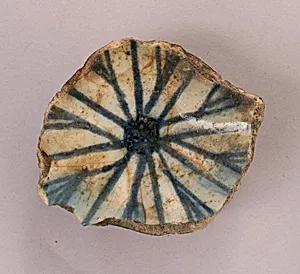
Medium
Stonepaste; painted under transparent glaze
Dimensions
H. 13/16 in. (2.1 cm) W. 2 9/16 in. (6.5 cm) D. 2 3/16 in. (5.6 cm) Wt. 1.1 oz. (31.188 g)
Classification
Ceramics
Department
Islamic Art
Museum
Metropolitan Museum of Art, New York, NY
Credit
Gift of Jack A. Josephson, 1973
Accession Number
1973.79.32
Rights
Public Domain
Art Historical Context
This delicate fragment from a bowl or cup, dating to the 13th–16th century, offers a glimpse into the refined world of Islamic ceramics.ed from stonepaste—a composite of quartz, clay, and frit—this small piece (just 13/16 inch high) exemplifies a groundbreaking medium developed in the Islamic world.isans fired the stonepaste body and then painted intricate designs under a transparent glaze, creating vibrant, durable colors that mimicked the prized Chinese porcelain unavailable at the time. Though only a fragment survives, its curved form hints at the elegant tableware used in daily life and elite households across the Middle East and beyond. Stonepaste ceramics flourished during this era, particularly in regions like Iran and Syria, where potters innovated to achieve translucency and strength. The underglaze technique allowed for bold motifs—often geometric patterns, floral motifs, or calligraphy—that reflected Islamic artistic principles of harmony and abstraction. This fragment, gifted to the Metropolitan Museum of Art in 1973 by Jack A. Josephson, underscores the cultural exchange along Silk Road trade routes, where such wares symbolized sophistication and technical mastery. Today, it invites us to ponder the skilled hands behind everyday objects, preserving a shard of medieval Islamic ingenuity for modern eyes.