
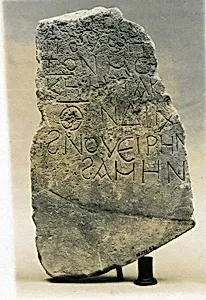
Fragment of an Inscribed Stele
Unknown Artist
6th–7th century
Medium
Limestone; incised
Dimensions
H. 21 5/8 in. (55 cm) W. 13 3/8 in. (34 cm) D. 4 3/4 in. (12 cm)
Classification
Sculpture
Department
Islamic Art
Museum
Metropolitan Museum of Art, New York, NY
Credit
Rogers Fund, 1910
Accession Number
10.175.63
Rights
Public Domain
Art Historical Context
This intriguing *Fragment of an Inscribedle* from the 6th–7th offers a window into the early Islamic world. Carved from limestone, this upright stone slab—measuring about 21½ inches tall—is a partial survivor of what was likely a larger commemorative or funerary monument. Its incised inscriptions, meticulously carved into the surface, reflect the epigraphic traditions of the time, where text served as a vital means of recording names, dates, prayers, or dedications. The medium of limestone was prized in the ancient Near East for its workability and durability, allowing artisans to create precise, linear incisions that ensured legibility over centuries. Dating to a pivotal era bridging late antiquity and the dawn of Islam, this piece exemplifies early stone sculpture techniques in the Islamic tradition, where script became an art form itself, evolving toward the angular Kufic style. Housed in the Metropolitan Museum of Art's Department of Islamic Art (acquired through the Rogers Fund in 1910), this fragment invites us to ponder the daily lives and beliefs of people from over 1,300 years ago. Though incomplete, it stands as a testament to the enduring cultural role of inscribed monuments in preserving memory and faith.