
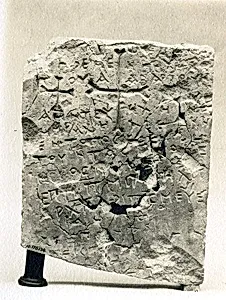
Fragment of an Inscribed Stele with Three Crosses
Unknown Artist
6th–7th century
Medium
Limestone; incised
Dimensions
H. 15 3/4 in. (40 cm) W. 12 1/4 in. (31.1 cm) D. 2 3/8 in. (6 cm)
Classification
Sculpture
Department
Islamic Art
Museum
Metropolitan Museum of Art, New York, NY
Credit
Rogers Fund, 1910
Accession Number
10.175.130
Rights
Public Domain
Art Historical Context
This intriguing fragment of an inscribed limestone stele, dating to the 6th–7th century, offers a glimpse into the religious and cultural transitions of late antiquity in the Near East Carved with three prominent crosses and accompanying inscriptions, it likely served as part of a funerary or commemorative monument, a common use for such stelae in early Christian communities. Measuring just 15 3/4 inches high, 12 1/4 inches wide, and 3/8 inches deep, its modest scale belies its historical weight, acquired by the Metropolitan Museum of Art through the Rogers Fund in 1910. The incised technique—precise lines carved into the durable limestone surface—highlights the sculptor's skill in creating enduring symbols of faith amid a shifting world. The three crosses evoke Christian iconography, possibly representing the Crucifixion or a trinitarian motif, during a time when Byzantine Christianity coexisted with the emerging Islamic world. Housed in the Met's Islamic Art department, this piece underscores the region's rich intercultural exchanges, bridging late antique traditions with early medieval developments. Though incomplete, the stele's survival speaks to the resilience of such artifacts, inviting us to ponder the lives and beliefs of its creators in a pivotal era.