
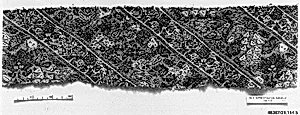
Fragment of Woman's Trousering
Unknown Artist
17th–18th century
Medium
Silk on linen; embroidered
Dimensions
H. 21 3/4 in. (55.2 cm) W. 4 1/4 in. (10.8 cm)
Classification
Textiles-Embroidered
Department
Islamic Art
Museum
Metropolitan Museum of Art, New York, NY
Credit
Gift of Lily S. Place, 1921
Accession Number
21.114.5
Rights
Public Domain
Art Historical Context
This exquisite fragment of woman's trousering, dating to the 17th–18th century, offers a glimpse into the refined world of Islamic textiles. Housed in the Metropolitan Museum of Art's Department of Islamic Art, this narrow strip—measuring 21¾ inches high and just 4¼ inches wide likely part of the decorative banding on traditional loose-fitting trousers (shalwar) worn by women the Ottoman Empire, Safavid Persia, or related regions. Donated in 1921 by Lily S. Place, it survives as a testament to the era's masterful craftsmanship, when such garments blended functionality with opulent adornment. Crafted from silk threads embroidered onto a linen ground, the piece highlights the technical prowess of anonymous artisans. Silk embroidery, prized for its luster and durability, was a labor-intensive technique often featuring intricate floral or geometric patterns symbolizing prosperity and beauty in Islamic culture. These textiles not only elevated everyday wear to art but also signified social status, as fine needlework demanded skilled hands and rare materials. Today, this fragile survivor underscores the cultural importance of embroidered textiles in Islamic societies, where clothing served as a canvas for personal expression and regional identity. A quiet marvel amid grander paintings and sculptures, it invites us to appreciate the artistry woven into the fabric of daily life.