
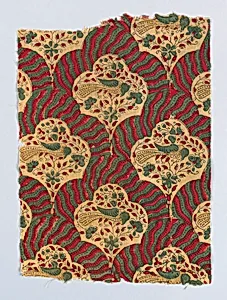
Fragment
ca. 1840
Classification
printed, dyed & painted textiles
Department
Smithsonian Collection
Museum
Smithsonian American Art Museum
Credit
Gift of Joseph K. Miller
Accession Number
1926-20-24
Rights
Public Domain
About this artwork
Research in Progress
Art Historical Context
This enigmatic *Fragment* from around 1840 offers a glimpse into the vibrant world of 19th-century American textiles. Classified as a printed, dyed and painted textile, it the craftsmanship of an era when fabric production blended artisanal skill with emerging industrial techniques. During the 1840s, America was in the midst of rapid textile innovation, fueled by the cotton boom and factories like those in Lowell, Massachusetts, where printed calicos and dyed patterns adorned clothing, quilts, and home furnishings for a growing middle class. The combination of printing, dyeing, and painting techniques suggests a layered process—perhaps block printing for bold motifs, resist dyeing for color separation, and hand-painting for intricate details. Such methods were labor-intensive yet accessible, reflecting cultural values of beauty and utility in everyday life. As a surviving fragment, it hints at larger narratives: a remnant of a garment, curtain, or bedcover that once brightened a home. Housed in the Smithsonian American Art Museum's Smithsonian Collection, this piece was generously gifted by Joseph K. Miller. With research ongoing, it invites us to ponder the anonymous hands behind its creation and its role in shaping American visual culture. A small treasure, it reminds us how textiles wove stories into the fabric of history.
About the Artist
Unknown
The artist designated as "Unknown" in our virtual museum's collection exemplifies a poignant chapter in art history: creators whose identities have faded into obscurity despite the enduring power of their work. With only one known artwork attributed to them in our holdings, this figure represents countless anonymous hands that shaped visual culture across centuries. Museums worldwide, including th...