
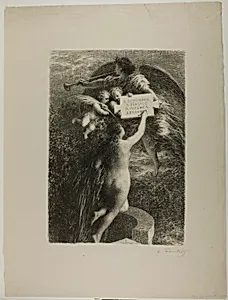
Frontispiece: Truth
Medium
Lithograph in black with scraping on stone on cream laid paper
Dimensions
Image: 45.7 × 32.2 cm (18 × 12 11/16 in.); Sheet: 69.5 × 52.4 cm (27 3/8 × 20 11/16 in.)
Classification
lithograph
Department
Prints and Drawings
Museum
Art Institute of Chicago
Accession Number
44047
Rights
Public Domain
About this artwork
In addition to the work of Wagner, Fantin was influenced by other great operas composed during his lifetime. In this lithograph a muse inscribes the names of composers whose music most inspired Fantin' s lithographs. The trumpeting figure above the scroll symbolizes fame.
Art Historical Context
Henri Fantin-Latour's *Frontispiece: Truth (1885) is a striking lithograph created as an illustrative frontispiece, the decorative image typically facing a book's title page. The French artist, renowned for his meticulous portraits and still lifes during the late 19th, bridges Realism and Symbolism in his prints. This work, housed in the Art Institute of Chicago's Prints Drawings department, captures the era's fascination with allegory, using "Truth" as a potent emblem amid shifting artistic and philosophical currents in fin-de-siècle Europe. Executed in black ink with scraping on lithographic stone onto cream laid paper, the medium exemplifies lithography's versatility. Fantin-Latour drew directly on the stone, a technique allowing for rich tonal gradations and fine details through the greasy crayon process, followed by chemical printing. The scraping method—likely removing ink or crayon for highlights and textures—enhances luminosity and depth, making this 45.7 × 32.2 cm image (sheet: 69.5 × 52.4 cm) a technical marvel of the printmaking revival in 1880s Paris. As a frontispiece, it likely introduced a publication exploring truth's elusive nature, reflecting Fantin-Latour's circle of Realist peers like Manet and Whistler. Its preservation on laid paper underscores the enduring appeal of 19th-century lithography for collectors, blending artistry with reproducibility. Visitors will appreciate its subtle elegance, a window into an artist's quiet mastery.
About the Artist
Henri Fantin-Latour · 1836–1904
Ignace Henri Jean Théodore Fantin-Latour was born on January 14, 1836, in Grenoble, France, to portrait painter Théodore Fantin-Latour, who gave him his earliest drawing lessons. The family relocated to Paris in 1841, where in 1850, at age 14, he enrolled in the École de Dessin, studying under Horace Lecoq de Boisbaudran, whose innovative memory-based method of drawing from observation profoundly ...