
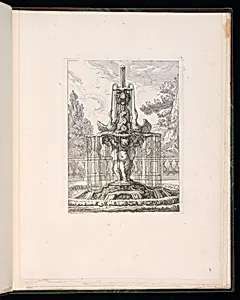
Garden Fountain
Classification
Department
Smithsonian Collection
Museum
Smithsonian American Art Museum
Credit
Purchased for the Museum by the Advisory Council
Accession Number
1921-6-442-4
Rights
Public Domain
About this artwork
Research in Progress
Art Historical Context
**Garden Fountain** (1753) is a delicate print by Charles Eisen, a prominent French artist (1720–1778) renowned for his Rococo elegance. Active during the lavish reign of Louis XV, Eisen served as the king's chief engraver, crafting intricate illustrations for books by Voltaire and others. This work, created at the height of the Rococo movement, likely captures the playful, ornate beauty of an 18th-century French garden—think cascading water, sculpted figures, and lush foliage symbolizing nature's harmonious luxury. As a print, *Garden Fountain* exemplifies Eisen's mastery of engraving techniques, allowing for precise lines and subtle shading that brought aristocratic fantasies to life on paper. Rococo art emphasized asymmetry, curves, and whimsy, reacting against Baroque grandeur, and Eisen's output often adorned elite homes and publications, spreading French taste across Europe. Though the exact medium details await further research, its classification highlights the era's innovative printmaking, which democratized high art. Acquired by the Smithsonian American Art Museum through the Advisory Council, this piece invites visitors to ponder the refined pleasures of Enlightenment-era France. Imagine the murmur of fountains in Versailles' gardens—Eisen's vision revives that serene splendor for us today.