
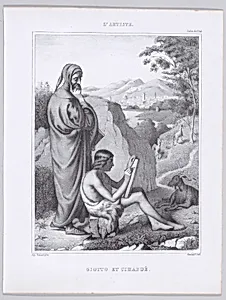
Giotto and Cimabue, from "L'Artiste"
Medium
Lithograph
Dimensions
Sheet: 11 13/16 × 9 1/16 in. (30 × 23 cm) Image: 8 7/8 × 6 13/16 in. (22.6 × 17.3 cm)
Classification
Prints
Department
Drawings and Prints
Museum
Metropolitan Museum of Art, New York, NY
Credit
Gift of Donato Esposito, 2019
Accession Number
2019.279.1
Rights
Public Domain
Art Historical Context
This lithograph, published in the French journal *L'Artiste* on July 7, 1844, captures a pivotal moment in art history by portraying the legendary relationship between the 13th-century Italian painters Cimabue and his pupil Giotto di Bondone. The image reflects the 19th-century fascination with these early Renaissance figures, who were celebrated for breaking from the rigid Byzantine style toward greater naturalism and emotional expression in painting. Created through lithography—a medium prized for its ability to reproduce delicate tonal effects and fine details—the print allowed wider audiences to engage with celebrated historical subjects. The work’s publication in *L’Artiste*, a leading periodical that promoted contemporary and historical art, underscores the Romantic era’s revival of interest in medieval and early Renaissance masters. By the 1840s, artists and critics looked back to Cimabue and Giotto as foundational figures who paved the way for later developments in Italian painting. The lithograph thus serves not only as an homage but also as a vehicle for educating a growing public about the origins of Western art traditions. Measuring just under 9 by 7 inches in the image area, this modest yet evocative print highlights how reproductive techniques democratized access to art historical narratives during the 19th century. Its presence in the Metropolitan Museum’s collection, acquired as a gift in 2019, continues that mission today, inviting viewers to reflect on the enduring legacy of these pioneering artists.
About the Artist
Giovanni Cimabue|Armand Vastine|Alphonse Hennet|Giotto di Bondone (British|Italian) · 1734 |1240 –1802 |1302
British, Beckside, Lancashire 1734–1802 Kendal, Cumbria|Italian, ca. 1240–before 1302