
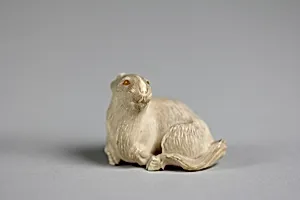
Goat
Unknown Artist
late 19th century
Medium
Ivory, glass eyes
Dimensions
H. 1 in. (2.5 cm); W. 1 1/2 in. (3.8 cm); D. 1 in. (2.5 cm)
Classification
Netsuke
Culture & Period
Japan · Meiji period (1868–1912)
Department
Asian Art
Museum
Metropolitan Museum of Art, New York, NY
Credit
Bequest of Stephen Whitney Phoenix, 1881
Accession Number
81.1.75
Rights
Public Domain
Tags
Art Historical Context
Discover the charming "Goat," a delicate netsuke carved from ivory in late 19th Japan during the Meiji (1868–1912). Standing just 1 inch tall, this tiny sculpture captures a goat in a lively, naturalistic pose, its glass eyes gleaming with lifelike sparkle. Netsuke like this were essential accessories in traditional Japanese dress, serving as toggles to secure inro pouches—small lacquered boxes for medicines or seals—to an obi sash. Crafted by an unknown artist, its compact form (H. 1 in.; W. 1 ½ in.; D. 1 in.) showcases the exquisite precision of ivory carving, a prized medium for its smooth texture and ability to hold fine details. In the Meiji era, Japan blended ancient craftsmanship with Western influences amid rapid modernization, yet netsuke endured as symbols of cultural heritage. Goats, often depicted in netsuke for their spirited nature and zodiac associations, embodied playfulness and resilience. The use of inset glass eyes enhanced realism, a technique that elevated these functional objects to wearable art. Bequeathed to the Metropolitan Museum of Art in 1881 by Stephen Whitney Phoenix, this piece from the Asian Art department invites us to marvel at Japan's masterful miniature tradition—proof that great artistry thrives in the smallest scales.