
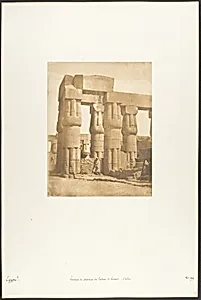
Groupe de colonnes du Palais de Louxor, Thèbes
1849–50
Medium
Salted paper print from paper negative
Dimensions
Image: 8 7/16 × 6 9/16 in. (21.4 × 16.6 cm) Mount: 12 5/16 × 18 11/16 in. (31.2 × 47.5 cm)
Classification
Photographs
Department
Photographs
Museum
Metropolitan Museum of Art, New York, NY
Credit
Gilman Collection, Gift of The Howard Gilman Foundation, 2005
Accession Number
2005.100.376.49
Rights
Public Domain
Tags
Art Historical Context
In the mid-19th century, as photography emerged as a revolutionary tool for documenting the world's wonders, French writer and photographer Maxime Du Camp captured the majestic ruins of ancient Egypt during his 1849–50 expedition alongside Gustave Flaubert. *Groupe de colonnes du Palais de Louxor, Thèbes* showcases a cluster of towering columns from the Luxor Temple complex in Thebes (modern Luxor), their weathered hieroglyphs and intricate carvings frozen in time. This salted paper print from a paper negative—one of the earliest photographic processes invented by William Henry Fox Talbot—measures a modest 8 7/16 × 6 9/16 inches, yet conveys the grandeur of pharaonic architecture with remarkable clarity and tonal subtlety. Du Camp's images, published in his pioneering 1852 album *Egypte, Nubie, Palestine et Syrie*, were among the first photographs to bring Egypt's ancient splendor to European audiences, fueling Egyptomania and scholarly interest in archaeology. The salted paper technique, involving silver salts on paper exposed to light, produced soft, luminous prints that emphasized texture and shadow, ideal for evoking the atmospheric mystery of sun-baked ruins. Today, housed in the Metropolitan Museum of Art's Gilman Collection, this work highlights photography's role in preserving cultural heritage, bridging antiquity and modernity for generations of visitors.
About the Artist
Maxime Du Camp · 1822–present
Maxime Du Camp (1822–1894) was a pioneering French photographer and writer whose adventurous spirit and technical innovation bridged literature and visual art during the mid-19th century. Born in Paris on February 8, 1822, to a prosperous family—his father a successful surgeon—Du Camp received a solid bourgeois education at the Collège Bourbon (now Lycée Condorcet), where he cultivated interests i...