
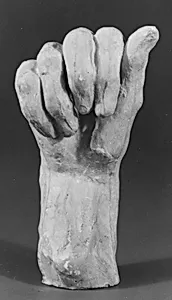
Hand
modeled possibly ca. 1886–89
Medium
Cast plaster
Dimensions
Length: 3 1/8 in. (7.9 cm)
Classification
Sculpture
Culture
French
Department
European Sculpture and Decorative Arts
Museum
Metropolitan Museum of Art, New York, NY
Credit
Presented by Rodin to his pupil Malvina Hoffman and given by her to The Metropolitan Museum of Art, Bequest of Malvina C. Hoffman, 1966
Accession Number
66.247.4
Rights
Public Domain
Tags
Art Historical Context
In the late 1880s, Auguste Rodin, the pioneering French sculptor who bridged Realism and Impressionism, crafted this intimate study titled *Hand*. Modeled possibly between 1886 and 1889, it exemplifies Rodin's fascination with the human form's expressive potential. At just 3 1/8 inches long, this cast plaster piece captures the subtle tension and anatomy of a clenched fist, rendered with his signature rough, textured surface that suggests movement and life beneath the skin. Rodin often isolated body parts like hands for detailed study, using them as building blocks for larger masterpieces such as *The Gates of Hell* and *The Thinker*, where hands convey profound emotion and narrative. Plaster casts like this served as vital preparatory tools in Rodin's studio, allowing him to experiment with light, shadow, and form before committing to bronze. This small sculpture highlights his revolutionary technique: abandoning polished neoclassical ideals for raw, fragmented realism that mirrored the fleeting qualities of light and flesh. Its cultural resonance lies in Rodin's influence on modern sculpture, emphasizing psychology over perfection. A cherished gift from Rodin to his American pupil Malvina Hoffman—a sculptor in her own right—this work entered The Metropolitan Museum of Art through her bequest in 1966. Today, it invites visitors to marvel at the power packed into a single hand, a testament to Rodin's genius for the monumental in miniature.
About the Artist
Auguste Rodin · 1840–1917
François Auguste René Rodin (1840-1917) stands as the founder of modern sculpture, transforming the art form from academic tradition into expressive modernism. Born into a working-class Parisian family, Rodin faced early rejection, failing three times to gain admission to the prestigious École des Beaux-Arts. This setback forced him to work as a craftsman for nearly two decades, though his 1875 tr...