
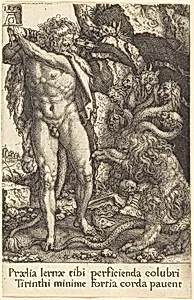
Hercules Fighting with the Hydra of Lernea
Classification
Department
CG-E
Museum
National Gallery of Art, Washington, D.C.
Credit
Rosenwald Collection
Accession Number
1943.3.252
Rights
Public Domain
Art Historical Context
In the National Gallery of Art's Rosenwald Collection, Heinrich Aldegrever's 1550 print *Hercules Fighting with the Hydra of Lernea* captures one of the most dramatic episodes from Greek mythology. The hero Hercules battles the monstrous Hydra, a multi-headed serpent from the swamps of Lerna whose heads regenerate when severed—a perilous second labor assigned by King Eurystheus. Aldegrever, a leading German engraver of the Northern Renaissance and one of the "Little Masters," renders this timeless tale of heroism with intricate precision, showcasing his mastery of fine lines and dynamic composition typical of small-scale prints. Created during the mid-16th century in Soest, Germany, the work reflects the era's fascination with classical myths, revived through humanism and the printing revolution. Aldegrever, influenced by Albrecht Dürer, elevated engraving from mere reproduction to an art form, distributing these affordable prints across Europe to inspire collectors and scholars. Though the exact medium remains unspecified, its classification as a print underscores the technique's revolutionary role in democratizing art. This piece not only highlights Hercules as a symbol of human triumph over chaos but also Aldegrever's technical virtuosity, inviting viewers to marvel at the tension between man and myth in a single, enduring image. (198 words)
About the Artist
Heinrich Aldegrever · 1502–1561
Heinrich Aldegrever, born in 1502 in Paderborn, Westphalia, to parents Herman and Katherine Trippenmeker—a family of clog-makers known by the dialect name Trippenmecker—emerged as a multifaceted artist in the German Renaissance. His early training remains undocumented, though he likely apprenticed in a Soest goldsmith's workshop after relocating there around 1525, where he joined the painters' gui...