
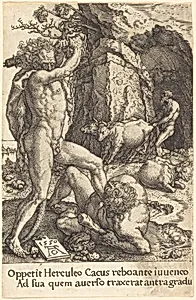
Hercules Killing Cacus
Classification
Department
CG-E
Museum
National Gallery of Art, Washington, D.C.
Credit
Rosenwald Collection
Accession Number
1943.3.251
Rights
Public Domain
Art Historical Context
In the National Gallery of Art's Rosenwald Collection, Heinrich Aldegrever's *Hercules Killing Cacus* (1550) captivates with its dynamic depiction of a classic mythological showdown. Aldegrever, a prominent German engraver and goldsmith from the Northern Renaissance, belonged to the "Little Masters"—artists celebrated for their virtuoso small-scale prints. This work, classified as a print (likely an engraving), exemplifies the era's technical precision, where fine lines conveyed drama and detail on a modest plate. The scene draws from ancient Roman lore, as told by Virgil in the *Aeneid*: Hercules slays the fire-breathing giant Cacus, who had stolen the hero's cattle and hidden them in a cave. Aldegrever captures the raw power of this twelfth labor, emphasizing Hercules' muscular triumph over chaos—a popular Renaissance motif symbolizing virtue conquering vice amid the era's humanist revival of classical myths. Prints like this revolutionized art dissemination in 16th-century Europe, making high art accessible beyond wealthy patrons through affordable reproductions. Aldegrever's meticulous technique, influenced by Albrecht Dürer, invites viewers to marvel at the interplay of light, shadow, and anatomy, offering a window into Renaissance ingenuity and enduring fascination with heroic legends. (198 words)
About the Artist
Heinrich Aldegrever · 1502–1561
Heinrich Aldegrever, born in 1502 in Paderborn, Westphalia, to parents Herman and Katherine Trippenmeker—a family of clog-makers known by the dialect name Trippenmecker—emerged as a multifaceted artist in the German Renaissance. His early training remains undocumented, though he likely apprenticed in a Soest goldsmith's workshop after relocating there around 1525, where he joined the painters' gui...