
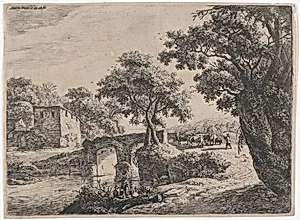
Herd Near a Stone Bridge
17th century
Medium
Etching
Dimensions
sheet: 5 15/16 x 8 1/16 in. (15.1 x 20.5 cm)
Classification
Prints
Department
Drawings and Prints
Museum
Metropolitan Museum of Art, New York, NY
Credit
Gift of Kenneth Grebinar, 2005
Accession Number
2005.377.32
Rights
Public Domain
Tags
Art Historical Context
Anthonie Waterloo, a Dutch artist active during the 17th century, specialized in landscape etchings that captured the quiet beauty of the countryside. Working in the Dutch Golden Age, he produced numerous prints that reflected a growing appreciation for natural scenery among collectors and viewers. His works often featured rural motifs drawn from everyday life, rendered with careful attention to light and atmosphere. In "Herd Near a Stone Bridge," Waterloo depicts a tranquil scene of cows gathered near an arched stone bridge, blending elements of pastoral life with architectural detail. The modest dimensions of the sheet invite close viewing, highlighting the intimate scale typical of etchings from this period. Etching allowed artists like Waterloo to create fine lines and tonal variations that evoke texture in foliage, water, and stone. This print, now part of the Metropolitan Museum of Art’s Drawings and Prints collection, exemplifies how 17th-century Dutch printmakers made landscape imagery widely accessible through reproducible media. Its gift to the museum in 2005 continues to offer visitors a glimpse into the era’s fascination with harmonious rural settings.
About the Artist
Anthonie Waterloo · 1609–1690
Anthonie Waterloo (1609–1690) was a prominent Dutch Golden Age landscape artist, born on May 6 in Lille, then part of the Spanish Netherlands. Little is known of his early life beyond his mother, Magdalena Vaillant, who joined Amsterdam's Walloon Church in 1621, with Waterloo following in 1630; no records exist of formal training, and he was likely self-taught. Registered as a painter in Amsterdam...