
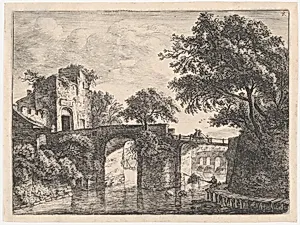
Two Stone Bridges
17th century
Medium
Etching
Dimensions
sheet: 6 1/8 x 8 1/4 in. (15.5 x 21 cm)
Classification
Prints
Department
Drawings and Prints
Museum
Metropolitan Museum of Art, New York, NY
Credit
Gift of Kenneth Grebinar, 2005
Accession Number
2005.377.31
Rights
Public Domain
Tags
Art Historical Context
In the serene etching *Two Stone Bridges*, 17th-century Dutch artistthonie Waterloo captures the tranquil beauty of a pastoral landscape. Born around 1609, Waterloo was a master of intricate landscape prints, drawing inspiration from the Dutch Golden Age's fascination with nature. His works often evoke the quiet harmony of rural scenes, blending meticulous detail with atmospheric depth, much like contemporaries such as Rembrandt and Hercules Seghers. Rendered in etching—a revolutionary intaglio technique perfected in the 17th century— this print (measuring 6 1/8 x 8 1/4 inches) allowed for fine lines and textures that mimic the play of light on stone and water. The composition highlights two sturdy stone bridges arching over a waterway, with hints of fishing activity suggesting everyday life along Dutch waterways. Etchings like this were prized for their reproducibility, making high-quality landscapes accessible beyond oil paintings. Today, this gift to the Metropolitan Museum of Art's Drawings and Prints department exemplifies Waterloo's enduring legacy in printmaking. Visitors can appreciate how such works romanticized the Netherlands' watery terrain, reflecting cultural pride in engineering marvels like bridges amid a thriving fishing economy. A gem for lovers of Golden Age artistry!
About the Artist
Anthonie Waterloo · 1609–1690
Anthonie Waterloo (1609–1690) was a prominent Dutch Golden Age landscape artist, born on May 6 in Lille, then part of the Spanish Netherlands. Little is known of his early life beyond his mother, Magdalena Vaillant, who joined Amsterdam's Walloon Church in 1621, with Waterloo following in 1630; no records exist of formal training, and he was likely self-taught. Registered as a painter in Amsterdam...