
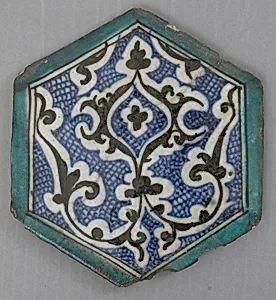
Hexagonal Tile
Unknown Artist
15th–16th century
Medium
Composite body; glazed
Dimensions
H. 7 in. (17.8 cm) W. 6 7/8 in. (17.5 cm)
Classification
Ceramics-Tiles
Department
Islamic Art
Museum
Metropolitan Museum of Art, New York, NY
Credit
Museum Accession
Accession Number
x.228.3
Rights
Public Domain
Art Historical Context
This exquisite hexagonal tile, crafted in the 15th–16th century, exemplifies masterful ceramic traditions of Islamic art. Measuring about 7 inches high and 7 inches wide, features a composite body—a durable mixture of quartz, clay, and frit—coated with a vibrant glaze that ensured longevity and a luminous sheen. Such tiles were ingeniously shaped to interlock seamlessly, forming expansive decorative panels that adorned mosques, palaces, and madrasas across the Islamic world. Produced during a golden age of Islamic craftsmanship, likely in regions like Persia, Syria, or the Ottoman Empire, this tile reflects the era's emphasis on geometric precision and opulent surface decoration. Glazing techniques allowed for rich blues, turquoise, and golds, symbolizing paradise gardens and evoking spiritual transcendence. Though the artist's identity is lost to time, the tile's survival highlights the technical innovation of Islamic potters, who perfected underglaze painting and firing methods to withstand centuries of use. Today, housed in the Metropolitan Museum of Art's Islamic Art Department, it invites us to imagine vast, shimmering walls that once transformed sacred spaces into visions of divine beauty—a testament to art's power to elevate everyday architecture.