
Hexagonal Tile
Unknown Artist
15th–16th century
Medium
Composite body; glazed
Dimensions
H. 6 5/8 in. (16.8 cm) W. 6 3/4 in. (17.1 cm)
Classification
Ceramics-Tiles
Department
Islamic Art
Museum
Metropolitan Museum of Art, New York, NY
Credit
Museum Accession
Accession Number
x.228.4
Rights
Public Domain
Tags
Art Historical Context
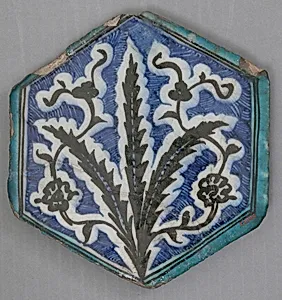
This hexagonal tile presents a striking floral design centered on a tall, spiky stem that rises from the base, flanked by curling white vines and stylized blossoms set against a rich cobalt blue ground. The pattern is framed by a narrow dark border, while the tile’s outer edges are finished in a soft turquoise glaze. Subtle variations in the blue tones and visible brushstrokes reveal the hand-painted underglaze technique, and faint cracks and wear along the edges speak to its age and use. Catalogued as an anonymous work from the fifteenth or sixteenth century, the tile is made of composite body and covered in glaze, a combination typical of ceramic production in the Islamic world. Such tiles were often created in sets to form larger decorative panels on walls or architectural surfaces, bringing color and pattern into spaces of daily or ceremonial life. Today this example from the Metropolitan Museum’s collection of Islamic Art offers visitors a close look at the refined geometry and natural motifs that artisans of the period combined so skillfully.