
Hongs-káy-dee, Great Chief, Son of The Smoke
1832
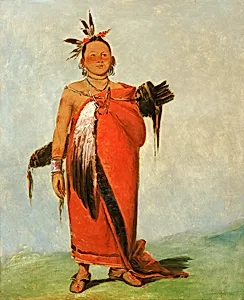
Medium
Painting
Classification
Painting
Department
Smithsonian Collection
Museum
Smithsonian American Art Museum
Credit
Smithsonian American Art Museum, Gift of Mrs. Joseph Harrison, Jr.
Accession Number
1985.66.97
Rights
Public Domain
Tags
About this artwork
George Catlin described Great Chief, son of the Ponca chief the Smoke, as a “youth of eighteen years . . . [who] distinguished himself in a singular manner the day before our steamer reached their village, by taking to him four wives in one day! This extraordinary and unprecedented freak of his, was just the thing to make him the greatest sort of medicine in the eyes of his people; and probably he may date much of his success and greatness through life, to this bold and original step, which sudd...
Art Historical Context
In 1832, artist George Catlin captured the likeness of Hongs-káy-dee, known as Great Chief and son of the Ponca leader The Smoke, during a visit to a Ponca village along the Missouri River. Catlin, a pioneering American painter renowned for his extensive portraits of Native American peoples, sought to document their lives and customs before rapid Western expansion altered them forever. This oil painting, now in the Smithsonian American Art, exemplifies Catlin's commitment to ethnographic realism, blending Romantic idealism with precise observation to honor his subjects' dignity. Catlin's own notes reveal the young man's audacious feat: at just 18, Great Chief took four wives in a single day, an act that catapulted him to legendary status among the Ponca as a figure of immense "medicine" or spiritual power. This portrait not only showcases Catlin's skillful rendering of facial features, traditional attire, and poised expression but also offers a window into Ponca cultural values, where bold personal achievements could propel one to leadership. As part of Catlin's seminal *Letters and Notes on the Manners, Customs, and Conditions of the North American Indians*, the work underscores the historical urgency of preserving Indigenous stories amid 19th-century change.
About the Artist
George Catlin · 1796–1872
George Catlin (1796–1872), born in Wilkes-Barre, Pennsylvania, to Putnam Catlin and Polly Sutton—who had been captured by Native Americans during the 1778 Battle of Wyoming—initially pursued a legal career. Trained at Litchfield Law School, he was admitted to the bar in 1819 but abandoned law after two years to study art in Philadelphia in 1823. Self-taught as a portraitist, Catlin quickly gained ...