
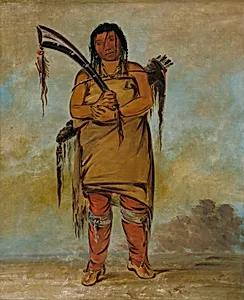
Wáh-chees, a Brave
1835 or 1836
Medium
Painting
Classification
Painting
Department
Smithsonian Collection
Museum
Smithsonian American Art Museum
Credit
Smithsonian American Art Museum, Gift of Mrs. Joseph Harrison, Jr.
Accession Number
1985.66.233
Rights
Public Domain
Tags
About this artwork
“The Menomonies. Like the Winnebagoes, are the remnant of a much more numerous and independent tribe, but have been reduced and enervated by the use of whiskey and the ravages of the small-pox, and number at this time, something like three thousand, living chiefly on the banks of Fox River, and the Western shore of Green Bay. They visit Prairie du Chien, where their annuities are paid them; and they indulge in the bane [of alcohol].” (Catlin, Letters and Notes, vol. 2, no. 52, 1841; reprint 1973...
Art Historical Context
George Catlin's *Wáh-chees, a* (1835 or 1836) captures the dignified likeness of a Menominee warrior during a pivotal era of American expansion. As a pioneering artist and ethnographer, Catlin traveled through the American West in the 1830s, painting over portraits of Native American leaders and everyday people. His oil painting, now in the Smithsonian American Art Museum exemplifies his commitment to documenting indigenous cultures before they were irrevocably altered by U.S. policies and settlement. In his *Letters and Notes* (1841), Catlin described the Menominee—once a powerful tribe—as diminished by smallpox epidemics and alcohol introduced by traders, numbering around 3,000 and residing along Fox River and Green Bay's western shore. They gathered at Prairie du Chien for annuity payments, where vices often prevailed. This portrait of Wáh-chees serves as a poignant visual record, highlighting the resilience of individuals amid tribal decline. Catlin's realistic style, with direct gazes and detailed regalia, lends historical authenticity, making the work a cultural treasure. It invites visitors to reflect on the human stories behind 19th-century frontier encounters.
About the Artist
George Catlin · 1796–1872
George Catlin (1796–1872), born in Wilkes-Barre, Pennsylvania, to Putnam Catlin and Polly Sutton—who had been captured by Native Americans during the 1778 Battle of Wyoming—initially pursued a legal career. Trained at Litchfield Law School, he was admitted to the bar in 1819 but abandoned law after two years to study art in Philadelphia in 1823. Self-taught as a portraitist, Catlin quickly gained ...