
Horizontal Panel with Three Birds, from Varii Generis Opera Aurifabris Necessaria
ca. 1600
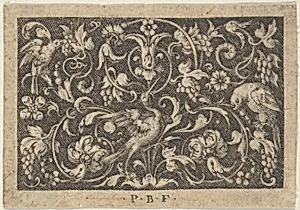
Medium
Engraving; second of two states (SKB)
Dimensions
Sheet: 1 7/16 × 2 1/16 in. (3.7 × 5.3 cm)
Classification
Prints|Ornament & Architecture
Department
Drawings and Prints
Museum
Metropolitan Museum of Art, New York, NY
Credit
The Elisha Whittelsey Collection, The Elisha Whittelsey Fund, 1959
Accession Number
59.600.82
Rights
Public Domain
Tags
Art Historical Context
Nestled within the intricate world of Renaissance ornamentation, *Horizontal Panel with Three Birds is a exquisite engraving by Paul Birckultz, created around 1600. This tiny print—measuring just 1 7/16 × 2 1/16 inches—forms part of *Varii Generis Operaifabris Necessaria*, a pattern book essential for goldsmiths and metalworkers. As the second of two states, it showcases refined details achieved through the meticulous burin work of engraving, a technique prized for its precision in reproducing complex motifs on metal plates. The composition features a horizontal panel alive with three graceful birds perched amid lush fruit and blooming flowers, evoking themes of abundance and nature's harmony. Such designs were not mere decoration but practical blueprints, adapted by artisans for jewelry, silverware, and architectural embellishments across Europe. Birckenhultz's work exemplifies the late Renaissance craze for pattern books, which democratized elaborate styles from elite workshops to broader crafts. Housed in the Metropolitan Museum of Art's Drawings and Prints department, this piece from The Elisha Whittelsey Collection highlights how prints bridged art and industry, influencing decorative arts well into the Baroque era. A testament to craftsmanship in miniature!
About the Artist
Paul Birckenhultz · 1561–1639
Paul Birckenhultz (1561–1634), also known as Paul Birckenholtz, was a German goldsmith, engraver, and draftsman born in Aachen. Little is known about his early life or formal training, though he emerged as a skilled artisan in the late Renaissance tradition of ornamental design. By the late 1580s, Birckenhultz had traveled extensively, working in Paris and Rome before settling permanently in Frank...