
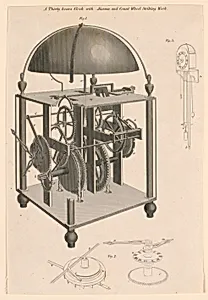
Horology: Thirty Hours Clock, pl. IX from "A Cyclopaedia of Horology - Rees's Clocks Watches and Chronometers"
1810-1842
Classification
Department
Smithsonian Collection
Museum
Smithsonian American Art Museum
Credit
Gift of Mrs. George A. Kubler
Accession Number
1949-152-41
Rights
Public Domain
About this artwork
Research in Progress
Art Historical Context
Step into the intricate world of 19th-century timekeeping with *Horology: Thirty Hours Clock, pl. IX* from Abraham Rees's monumental *A Cyclopaedia of Horology Rees's Clocks Watches and Chronometers*. Created between 1810 and 1842, this detailed print captures the mechanical elegance of a thirty-hour clock—a compact timepiece designed for short-duration operation, emblematic of the era's ingenuity in horology. Abraham Rees, a prolific British encyclopedist (1743–1825), compiled this comprehensive reference, blending scientific precision with visual clarity to educate artisans, scholars, and enthusiasts. As plate IX, this illustration exemplifies the technical engravings common in early encyclopedias, where accuracy trumped artistic flourish. Such prints were vital tools for disseminating clockmaking knowledge during the Industrial Revolution, when precise time measurement fueled advancements in navigation, industry, and daily life. Housed in the Smithsonian American Art Museum's collection—thanks to a gift from Mrs. George A. Kubler—this piece bridges art, science, and history, offering a window into how 18th- and 19th-century innovators tamed time itself. Today, it reminds us of horology's cultural role: clocks weren't just functional but symbols of progress and human mastery over the fleeting hour. Research continues to uncover more about this fascinating artifact.