
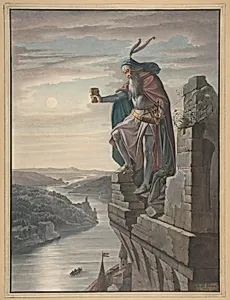
Illustration for Goethe
1842
Medium
Watercolor, over graphite (?). Three framing lines, the inner one in pen and brown ink, the outer ones in graphite.
Dimensions
sheet: 12 1/4 x 9 3/16 in. (31.1 x 23.4 cm) mount: 16 3/4 x 12 13/16 in. (42.5 x 32.6 cm)
Classification
Drawings
Department
Drawings and Prints
Museum
Metropolitan Museum of Art, New York, NY
Credit
Purchase, C. G. Boerner Gift, 2010
Accession Number
2010.274
Rights
Public Domain
Tags
Art Historical Context
Leopold Schulz's *Illustration for Goethe* (1842) captures a vivid, dramatic scene likely inspired by one of Johann Wolfgang von Goethe's literary masterpieces evoking the Romantic spirit of 19th-century Germany. Rendered in watercolor over graphite with intricate framing lines—inner in pen and brown ink, outer in—the drawing depicts men wielding swords amid rivers, boats, and drinking, suggesting a moment ofry, conflict, or adventure. Goethe, who died a decade earlier, profoundly influenced European arts and letters, and Schulz's work reflects the era's fascination with illustrating his epic tales like *Faust*, blending human drama with natural elements. This preparatory drawing, classified among the Metropolitan Museum of Art's Drawings and Prints, showcases Schulz's mastery of mixed media. Watercolor's fluidity allowed luminous effects on the river and boats, while graphite underdrawing provided precise contours for figures and props. At 12¼ x 9⅛ inches, its intimate scale invites close viewing, highlighting the technical finesse of framing that mimics a finished print or book plate. Acquired in 2010 through the C. G. Boerner Gift, this piece bridges literature and visual art, underscoring Goethe's enduring cultural legacy during the Biedermeier period—a time of refined domestic illustration amid political upheaval. Visitors will appreciate its storytelling power, a window into how artists visualized Germany's literary giants.
About the Artist
Leopold Schulz · 1804–1873
Leopold Schulz was born on October 25, 1804, in Vienna, the son of a porcelain painter. He pursued formal artistic training at the Academy of Fine Arts Vienna from 1817 to 1826, laying the foundation for a career focused on religious and historical subjects. Schulz died on October 6, 1873, in Heiligenstadt, Lower Austria. Schulz worked primarily as a church and portrait painter, specializing in h...