
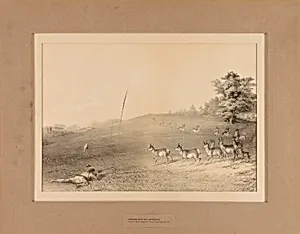
Indians Hunting Antelope--no. 20
Medium
Graphic Arts-Print
Classification
Graphic Arts-Print
Department
Smithsonian Collection
Museum
Smithsonian American Art Museum
Credit
Smithsonian American Art Museum, Transfer from the National Museum of Natural History, Department of Ethnology, Smithsonian Institution
Accession Number
1985.66.386,590Q
Rights
Public Domain
Tags
Art Historical Context
George Catlin's *Indians Hunting Antelope--no. 20* captures a dynamic moment in Native American life on the Great Plains, showcasing the artist's lifelong passion for documenting Indigenous cultures. In the 1830s, Catlin journeyed across the American West, painting hundreds of portraits, landscapes, and scenes like this one to preserve traditions he feared were vanishing due to European settlement. Though the exact date is unknown, this work belongs to his seminal series on Plains tribes, emphasizing their skill and harmony with nature. The print depicts a group of hunters pursuing antelope across a vast landscape, armed with bows and arrows—a testament to traditional hunting prowess essential for survival. Catlin's realistic style, rooted in Romanticism and early ethnography, blends vivid action with environmental detail, making viewers feel the thrill of the chase. As a graphic arts print, it democratized his oil paintings, allowing wider audiences to engage with these cultural snapshots. Housed in the Smithsonian American Art Museum, this piece from the Smithsonian Collection highlights Catlin's role as a pioneering visual anthropologist, offering a window into pre-reservation Native life and sparking appreciation for America's diverse heritage.
About the Artist
George Catlin · 1796–1872
George Catlin (1796–1872), born in Wilkes-Barre, Pennsylvania, to Putnam Catlin and Polly Sutton—who had been captured by Native Americans during the 1778 Battle of Wyoming—initially pursued a legal career. Trained at Litchfield Law School, he was admitted to the bar in 1819 but abandoned law after two years to study art in Philadelphia in 1823. Self-taught as a portraitist, Catlin quickly gained ...