
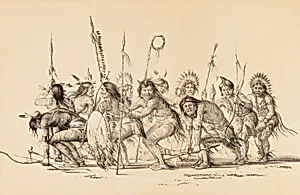
Indians in a Circle, Dancing--no. 30
Medium
Graphic Arts-Print
Classification
Graphic Arts-Print
Department
Smithsonian Collection
Museum
Smithsonian American Art Museum
Credit
Smithsonian American Art Museum, Transfer from the National Museum of Natural History, Department of Ethnology, Smithsonian Institution
Accession Number
1985.66.386,590Y
Rights
Public Domain
Tags
Art Historical Context
George Catlin's *Indians in a Circle, Dancing--no. 30* captures a vibrant moment of Native American cultural life, likely inspired by the artist's extensive travels among Indigenous tribes in the 1830s. Catlin, a pioneering 19th-century American painter, dedicated his career to documenting the customs, portraits, and daily rituals of Plains Indians before rapid westward expansion and assimilation efforts threatened their traditions. This graphic arts print depicts a group of figures engaged in a traditional circle dance, a communal ceremony central to many tribes for storytelling, celebration, or spiritual connection. As part of Catlin's renowned "Indian Gallery" series—over 600 works created from direct observation—this piece exemplifies his realistic style, blending Romantic idealism with ethnographic accuracy. Prints like this one allowed wider dissemination of his images when original oil paintings were exhibited across Europe and America, raising awareness of Native cultures at a time when they were often romanticized or vilified in popular media. Housed in the Smithsonian American Art Museum, transferred from the National Museum of Natural History's ethnology collection, the work underscores the Smithsonian's role in preserving Indigenous heritage. Today, it invites visitors to reflect on the resilience of Native dances, many of which endure as living traditions.
About the Artist
George Catlin · 1796–1872
George Catlin (1796–1872), born in Wilkes-Barre, Pennsylvania, to Putnam Catlin and Polly Sutton—who had been captured by Native Americans during the 1778 Battle of Wyoming—initially pursued a legal career. Trained at Litchfield Law School, he was admitted to the bar in 1819 but abandoned law after two years to study art in Philadelphia in 1823. Self-taught as a portraitist, Catlin quickly gained ...