
Inspiration
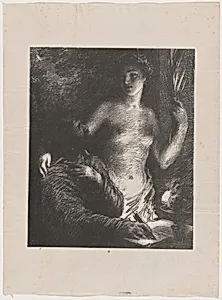
Medium
Lithograph in black on china paper
Dimensions
plate: 26.4 x 21.9 cm (10 3/8 x 8 5/8 in.) sheet: 38.4 x 28.6 cm (15 1/8 x 11 1/4 in.)
Classification
Department
CG-E
Museum
National Gallery of Art, Washington, D.C.
Credit
Virginia and Ira Jackson Collection, gift in memory of Virginia H. Jackson
Accession Number
1996.151.45
Rights
Public Domain
Art Historical Context
Henri Fantin-Latour's *Inspiration* (189) is a striking lithograph that exemplifies the French artist's mastery of printmaking in his later years. Born in 1836, Fantin-Latour was a figure in 19th-century Realism, for his intimate portraits of artists and writers, as well as lush still lifes. By the 1890s, he had turned increasingly to lithography, a medium that allowed him to translate his delicate drawing style into multiples with remarkable fidelity. This work, printed in black ink on delicate china paper—a thin, absorbent sheet prized for its ability to capture fine tonal gradations—measures 26.4 x 21.9 cm on the plate, inviting close contemplation of its subtle textures. Lithography, invented in the late 18th century, suited Fantin-Latour's precise technique, where greasy crayon marks on a limestone slab resist water and attract ink for printing. *Inspiration* reflects the era's fascination with muses and creative fervor, evoking Symbolist undertones amid Realism's clarity. Part of the National Gallery of Art's Virginia and Ira Jackson Collection (gift in memory of Virginia H. Jackson), it highlights how prints democratized access to high art, bridging studio intimacy with public appreciation. A gem for print enthusiasts, it whispers of the spark that fueled artistic genius.
About the Artist
Henri Fantin-Latour · 1836–1904
Ignace Henri Jean Théodore Fantin-Latour was born on January 14, 1836, in Grenoble, France, to portrait painter Théodore Fantin-Latour, who gave him his earliest drawing lessons. The family relocated to Paris in 1841, where in 1850, at age 14, he enrolled in the École de Dessin, studying under Horace Lecoq de Boisbaudran, whose innovative memory-based method of drawing from observation profoundly ...