
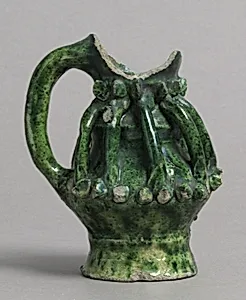
Jar
Unknown Artist
14th–15th century (?)
Medium
Earthenware, glaze
Dimensions
Overall: 3 11/16 x 3 1/8 x 2 1/2 in. (9.4 x 7.9 x 6.4 cm)
Classification
Ceramics
Culture
European
Department
Medieval Art
Museum
Metropolitan Museum of Art, New York, NY
Credit
Gift of J. Pierpont Morgan, 1917
Accession Number
17.194.1735
Rights
Public Domain
Art Historical Context
This delicate earthenware jar dating tentatively to the 14th–15th, exemplifies everyday medieval ceramics preserved for their subtle. Standing just under inches tall, its compact form—measuring 3 11/16 x 3 1/8 x 2 1/2 inches—suggests it served practical purposes, perhaps for storing spices, oils, or cosmetics in a household setting. Crafted during the late Middle Ages, a time when pottery production flourished across Europe amid growing trade and urbanization, this piece reflects the era's blend of utility and emerging aesthetic refinement. The jar's earthenware body, coated in glaze, highlights key medieval techniques. Earthenware, fired at lower temperatures than stoneware or porcelain, was widely accessible, allowing potters to produce durable vessels en masse. The glaze not only sealed the porous clay against liquids but also added a glossy sheen, often in earthy tones that evoked the natural world. Such innovations improved functionality while hinting at cultural exchanges, as glazing methods spread from Islamic influences via trade routes like the Mediterranean. A gift to the Metropolitan Museum of Art from financier J. Pierpont Morgan in 1917, this unassuming jar offers a window into anonymous artisans' skill, reminding us that medieval Europe's artistic legacy thrives in humble objects as much as grand cathedrals.