
Job's Despair
1825
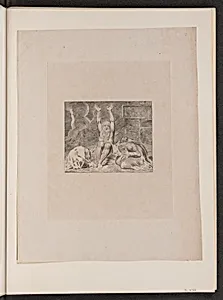
Medium
engraving on thin paper
Classification
Portfolio
Department
CG-E
Museum
National Gallery of Art, Washington, D.C.
Credit
Rosenwald Collection
Accession Number
1943.3.1683
Rights
Public Domain
Art Historical Context
William Blake's *Job's Despair* (1825), an engraving on thin paper, captures pivotal moment from the biblical Book of Job, where the righteous man grapples with profound suffering and loss. Part of Blake's monumental *Illustrations of the Book Job* series—his final major print project—this image is housed in the National Gallery of Art's Rosenwald CollectionDepartment CG-E, Portfolio classification). Blake, a visionary of the Romantic era (1757–1827), drew from his mystical interpretations of scripture to explore themes of faith, torment, and redemption, making this work a profound meditation on human endurance. Rendered in Blake's signature intricate line work, the engraving exemplifies his innovative relief etching technique combined with fine engraving, allowing for luminous detail on delicate thin paper. The composition likely conveys Job's anguish amid swirling forms symbolizing chaos and divine mystery, reflecting Blake's belief in the interplay between innocence and experience. These prints were hand-pulled in small editions, often colored by Blake himself, blending poetry, prophecy, and visual artistry. As a cornerstone of Romantic printmaking, *Job's Despair* highlights Blake's rebellion against industrial-age mechanization, favoring handmade spiritual expression. Visitors will appreciate its emotional depth, inviting reflection on life's trials through one of art history's most imaginative minds.
About the Artist
William Blake · 1757–1827
William Blake (1757–1827) stands as one of the most visionary and unconventional artists in British history, a poet-painter-printmaker whose mystical imagination and radical vision profoundly shaped the Romantic movement. Born in London's Soho district, Blake experienced visions from childhood—claiming to see angels in trees at age eight—and these spiritual encounters would guide his art throughou...