
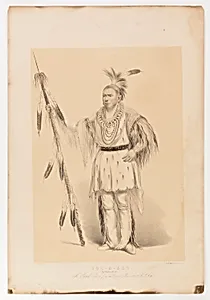
Joc-o-sot, the Walking Bear
Medium
Graphic Arts-Print
Classification
Graphic Arts-Print
Department
Smithsonian Collection
Museum
Smithsonian American Art Museum
Credit
Smithsonian American Art Museum, Transfer from the National Museum of Natural History, Department of Ethnology, Smithsonian Institution
Accession Number
1985.66.386,592D
Rights
Public Domain
Tags
Art Historical Context
**Joc-o-sot, the Walking Bear** is a striking full-length print by George Catlin, the pioneering 19th-century American artist for his vivid documentation of Native American life. Captured in the graphic arts medium, this work from the Smithsonian American Art Museum's collection portrays Joc-o-sot, a Sauk warrior also known as "The Walking." Catlin's realistic style, rooted in his ethnographic travels across the Great Plains in the 1830s, aimed to preserve the dignity and customs of Indigenous peoples before widespread cultural disruption. This print likely reproduces one of Catlin's original portraits, showcasing his commitment to authenticity amid the era's fascination with "vanishing" Native cultures. Joc-o-sot himself gained fame touring Europe with other Natives, performing and defying stereotypes—facts that underscore the artwork's role in bridging worlds. Transferred from the National Museum of Natural History's Ethnology Department, it highlights the Smithsonian's early efforts to collect and share Indigenous representations. Artistically, the print medium allowed Catlin's images to reach broader audiences, amplifying their cultural impact. Today, it invites visitors to reflect on Native resilience and the complex legacy of 19th-century portraiture, blending admiration with the poignant realities of colonialism. (198 words)
About the Artist
George Catlin · 1796–1872
George Catlin (1796–1872), born in Wilkes-Barre, Pennsylvania, to Putnam Catlin and Polly Sutton—who had been captured by Native Americans during the 1778 Battle of Wyoming—initially pursued a legal career. Trained at Litchfield Law School, he was admitted to the bar in 1819 but abandoned law after two years to study art in Philadelphia in 1823. Self-taught as a portraitist, Catlin quickly gained ...