
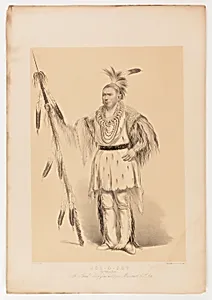
Joc-o-sot, the Walking Bear
Medium
Graphic Arts-Print
Classification
Graphic Arts-Print
Department
Smithsonian Collection
Museum
Smithsonian American Art Museum
Credit
Smithsonian American Art Museum, Transfer from the National Museum of Natural History, Department of Ethnology, Smithsonian Institution
Accession Number
1985.66.386,592P
Rights
Public Domain
Tags
Art Historical Context
**Joc-o-sot, the Walking Bear** is a striking full-length portrait by George Catlin, the pioneering 19th-century American artist for his vivid documentation of Native American life. Captured as a graphic arts print—likely a lithograph reproducing one of Catlin's original paintings—this undated work showcases Catlin's signature style: realistic, empathetic portrayals that honor the dignity and individuality of his subjects. Housed in the Smithsonian American Art Museum it exemplifies the artist's commitment to preserving Indigenous cultures through art. Catlin traveled extensively across the American West in the 1830s, painting over 600 portraits and scenes to create what he called an "Indian Gallery." This print reflects that mission, offering museum visitors a window into a vanishing world amid rapid European settlement. The full-length format allows us to appreciate the subject's poised stance and traditional attire, emphasizing cultural authenticity over exoticism. As part of the Smithsonian's collection, transferred from the National Museum of Natural History's ethnology department, *Joc-o-sot, the Walking Bear* holds enduring historical value. It invites reflection on Native American resilience and the power of visual records in bridging past and present, reminding us of Catlin's role in early ethnographic art. (198 words)
About the Artist
George Catlin · 1796–1872
George Catlin (1796–1872), born in Wilkes-Barre, Pennsylvania, to Putnam Catlin and Polly Sutton—who had been captured by Native Americans during the 1778 Battle of Wyoming—initially pursued a legal career. Trained at Litchfield Law School, he was admitted to the bar in 1819 but abandoned law after two years to study art in Philadelphia in 1823. Self-taught as a portraitist, Catlin quickly gained ...