
Joc-o-sot, the Walking Bear
n.d.
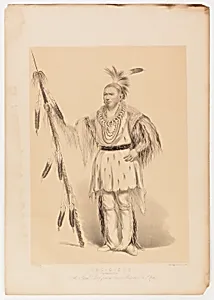
Medium
Graphic Arts-Print
Classification
Graphic Arts-Print
Department
Smithsonian Collection
Museum
Smithsonian American Art Museum
Credit
Smithsonian American Art Museum, Transfer from the National Museum of Natural History, Department of Ethnology, Smithsonian Institution
Accession Number
1985.66.386,592AAA
Rights
Public Domain
Tags
Art Historical Context
**Joc-o-sot, the Walking Bear** is a striking full-length portrait print by George Catlin, pioneering 19th-century American renowned for his documentation of Native American life Captured in graphic arts medium (likely a lithograph reproducing one of Catlin's oil paintings), this undated work from the Smithsonian American Art Museum a dignified Indigenous figure, evoking the strength and grace implied by his evocative name. Catlin traveled extensively among Plains tribes in the 1830s, creating an invaluable visual record of Native cultures on the brink of profound change due to westward expansion. Prints like this one democratized his art, allowing wider audiences to encounter authentic representations of Indigenous peoples beyond elite galleries. The "Indian" tag underscores its focus on Native American identity, highlighting Catlin's role in early ethnographic art. This piece holds cultural significance as a window into pre-reservation Native life, blending portraiture with advocacy for preservation. Its full-length format emphasizes presence and poise, inviting visitors to reflect on the humanity and resilience of figures like Joc-o-sot amid historical upheaval. A testament to Catlin's legacy in American art. (198 words)
About the Artist
George Catlin · 1796–1872
George Catlin (1796–1872), born in Wilkes-Barre, Pennsylvania, to Putnam Catlin and Polly Sutton—who had been captured by Native Americans during the 1778 Battle of Wyoming—initially pursued a legal career. Trained at Litchfield Law School, he was admitted to the bar in 1819 but abandoned law after two years to study art in Philadelphia in 1823. Self-taught as a portraitist, Catlin quickly gained ...