
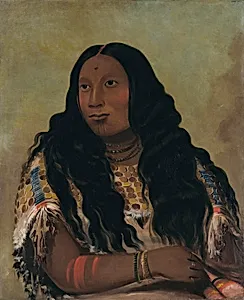
Tchón-su-móns-ka, Sand Bar, Wife of the Trader François Chardon
1832
Medium
Painting
Classification
Painting
Department
Smithsonian Collection
Museum
Smithsonian American Art Museum
Credit
Smithsonian American Art Museum, Gift of Mrs. Joseph Harrison, Jr.
Accession Number
1985.66.89
Rights
Public Domain
Tags
About this artwork
George Catlin described Sand Bar as “very richly dressed, the upper part of her garment being almost literally covered with brass buttons; and her hair, which was inimitably beautiful and soft, and glossy as silk, fell over her shoulders in great profusion, and in beautiful waves, produced by the condition in which it is generally kept in braids, giving to it, when combed out, a waving form, adding much to its native appearance, which is invariably straight and graceless . . . This woman is at p...
Art Historical Context
In 1832, renowned artist George Catlin painted this striking bust portrait of Tchón-su-móns-ka, known as Sand Bar, a Dakota (Sioux) woman at Fort Pierre in present-day South Dakota. As part of his ambitious project to document Native American life and cultures before they vanished under westward expansion, Catlin captured her during his travels among the tribes along the Upper Missouri River. Sand Bar was married to François Chardon, a French trader and interpreter for the American Fur Company, reflecting the cultural intersections at frontier trading posts where Native women often formed alliances with European men. Catlin marveled at her appearance in his *Letters and Notes*: richly dressed in a garment adorned with brass buttons—likely acquired through trade—and her glossy, wavy hair cascading luxuriantly after being unbraided, contrasting its natural straightness. This oil painting exemplifies Catlin's realistic style, emphasizing ethnographic detail over idealization to preserve authentic likenesses. Today, housed in the Smithsonian American Art Museum, the portrait offers a poignant glimpse into 19th-century Plains Indian life, blending indigenous beauty with the influences of fur trade commerce. It underscores Catlin's urgent mission to create a visual record of a fading world.
About the Artist
George Catlin · 1796–1872
George Catlin (1796–1872), born in Wilkes-Barre, Pennsylvania, to Putnam Catlin and Polly Sutton—who had been captured by Native Americans during the 1778 Battle of Wyoming—initially pursued a legal career. Trained at Litchfield Law School, he was admitted to the bar in 1819 but abandoned law after two years to study art in Philadelphia in 1823. Self-taught as a portraitist, Catlin quickly gained ...