
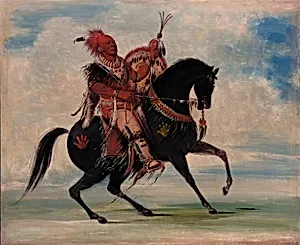
Kee-o-kúk, The Watchful Fox, Chief of the Tribe, on Horseback
1835
Medium
Painting
Classification
Painting
Department
Smithsonian Collection
Museum
Smithsonian American Art Museum
Credit
Smithsonian American Art Museum, Gift of Mrs. Joseph Harrison, Jr.
Accession Number
1985.66.1A
Rights
Public Domain
Tags
About this artwork
“After I had painted the portrait of this vain man at full length, and which I have already introduced, he had the vanity to say to me, that he made a fine appearance on horseback, and that he wished me to paint him thus. So I prepared my canvas in the door of the hospital which I occupied, in the dragoon cantonment; and he flourished about for a considerable part of the day in front of me, until the picture was completed. The horse that he rode was the best animal on the frontier; a fine bloode...
Art Historical Context
George Catlin's *Kee-o-kúk, The Watchful Fox Chief of the Tribe, Horseback* (1835) captures the Sauk and Fox leader in a striking equestrian portrait, showcasing his pride and status. Painted during Catlin's travels among Native American tribes in the 1830s, this oil painting is part of the artist's ambitious effort to document Indigenous peoples of the Great Plains before their cultures were irrevocably altered by westward expansion. Catlin, a pioneering American artist associated with Romanticism, specialized in vivid, ethnographic portraits that preserved vanishing traditions. As Catlin recounted in his *Letters and Notes* (1841), Kee-o-kúk—known for his vanity—insisted on this horseback depiction after a full-length portrait. Posing dramatically outside Catlin's makeshift studio in a U.S. Army dragoon cantonment, the chief rode his prized blooded horse, valued at $300, adorned with elaborate caparisons and scalps dangling from the bridle. As distributor of $50,000 in annual tribal annuities, Kee-o-kúk drew crowds of soldiers and officers, turning the session into a spectacle of Native finery and frontier life. This work highlights cultural exchanges on the evolving American frontier, blending Sauk traditions—like traditional dress and warrior trophies—with symbols of wealth and mobility. Now in the Smithsonian American Art Museum, it offers a window into a chief's self-presentation amid encroaching U.S. military presence.
About the Artist
George Catlin · 1796–1872
George Catlin (1796–1872), born in Wilkes-Barre, Pennsylvania, to Putnam Catlin and Polly Sutton—who had been captured by Native Americans during the 1778 Battle of Wyoming—initially pursued a legal career. Trained at Litchfield Law School, he was admitted to the bar in 1819 but abandoned law after two years to study art in Philadelphia in 1823. Self-taught as a portraitist, Catlin quickly gained ...