
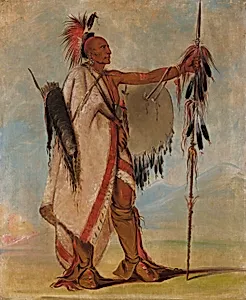
Tál-lee, a Warrior of Distinction
1834
Medium
Painting
Classification
Painting
Department
Smithsonian Collection
Museum
Smithsonian American Art Museum
Credit
Smithsonian American Art Museum, Gift of Mrs. Joseph Harrison, Jr.
Accession Number
1985.66.32
Rights
Public Domain
Tags
About this artwork
“Amongst the many brave and distinguished warriors of the tribe, one of the most noted and respected is Tal-lee, painted at full length, with his lance in his hand---his shield on his arm, and his bow and quiver slung upon his back. In this portrait, there is a fair specimen of the Osage figure and dress, as well as of the facial outline, and shape and character of the head, and mode of dressing and ornamenting it with helmet-crest, and the eagle's quill.” George Catlin painted the warrior at Fo...
Art Historical Context
In 1834, George Catlin captured the noble likeness of Tál-lee, a Osage warrior, in this striking full-length portrait painted at Fort Gibson in present-day Oklahoma. Cat, a pioneering American artist, depicted Tál-lee poised with his lance in hand, shield on his arm, and bow and quiver slung across his back. The painting serves as a vivid ethnographic study, showcasing the Osage man's physique, traditional dress, facial features, and elaborate head ornamentation—including a helmet-crest adorned with an eagle's qu. Catlin's work is part of his ambitious "Indian Gallery," a series of over 600 portraits created during his travels among Native American tribes in the 1830s. Amid the U.S. government's forced relocations under the Indian Removal Act, these paintings aimed to preserve vanishing cultures before assimilation or displacement. Rendered in oil with meticulous realism, Catlin's technique emphasized authentic details of regalia and posture, blending portraiture with documentary intent. Today, housed in the Smithsonian American Art Museum, *Tál-lee, a Warrior of Distinction* offers a poignant window into Osage heritage and the frontier era, reminding visitors of the resilience and dignity of Indigenous warriors. (198 words)
About the Artist
George Catlin · 1796–1872
George Catlin (1796–1872), born in Wilkes-Barre, Pennsylvania, to Putnam Catlin and Polly Sutton—who had been captured by Native Americans during the 1778 Battle of Wyoming—initially pursued a legal career. Trained at Litchfield Law School, he was admitted to the bar in 1819 but abandoned law after two years to study art in Philadelphia in 1823. Self-taught as a portraitist, Catlin quickly gained ...