
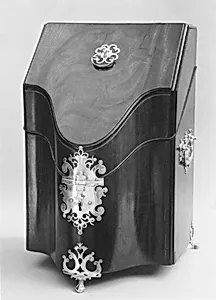
Knife Box
Medium
Mahogany, mahogany veneer, white pine, tulip poplar
Dimensions
14 3/8 x 8 3/4 x 8 7/8 in. (36.5 x 22.2 x 22.5 cm)
Classification
Knife box
Culture
American
Department
The American Wing
Museum
Metropolitan Museum of Art, New York, NY
Credit
Morris K. Jesup Fund, 1954
Accession Number
54.24.2
Rights
Public Domain
Art Historical Context
Nestled in The Metropolitan Museum of Art's American Wing, this elegant *Knife Box* (1765–95), crafted by New York cabinetmakers Lewis Fueter and his son Daniel Fueter Jr., exemplifies the refined craftsmanship of late colonial and early Federal America. Knife boxes like this one were essential household items, designed to store and display table cutlery on sideboards or buffets in prosperous homes. Standing at just 14 3/8 x 8 3/4 x 8 7/8 inches, its compact form belies its sophisticated construction, reflecting the Fueters' dual expertise as silversmiths and woodworkers. Fashioned from rich mahogany with mahogany veneer over white pine and tulip poplar secondary woods, the box showcases veneering techniques that allowed for intricate patterns and a luxurious surface finish—hallmarks of high-end American furniture making. The choice of mahogany, imported from the West Indies, signaled wealth and status, as it was prized for its durability and deep reddish hue that patinates beautifully over time. This piece, acquired through the Morris K. Jesup Fund in 1954, offers a window into 18th-century American domestic life, where functionality met artistry. The Fueters' work bridges European influences like Georgian symmetry with emerging American tastes, making it a treasured artifact of the nation's decorative arts heritage.
About the Artist
Lewis Fueter|Daniel Fueter Jr. ( |American) · 1766 |1783 –1775 |1806
active ca. 1769–75|active ca. 1786–1806