
Knife Urn
Unknown Artist
ca. 1820
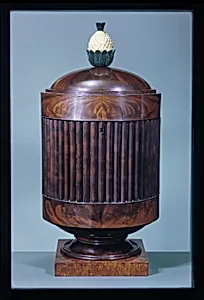
Medium
Mahogany, mahogany veneer, white pine, tulip poplar
Dimensions
25 11/16 x 12 1/2 in. (65.2 x 31.8 cm)
Classification
Knife urn
Culture
American
Department
The American Wing
Museum
Metropolitan Museum of Art, New York, NY
Credit
Purchase, Mrs. Russell Sage Gift, 1970
Accession Number
1970.260.2
Rights
Public Domain
Art Historical Context
Step into the refined world of early 19th-century American with the *Knife Urn*, a example of Federal-period furniture crafted around 1820 by an unknown artist. Standing at just over 25 inches tall, this compact urn-shaped case was designed to store dining knives safely away from damp conditions, preserving their edges between meals. Fashioned from luxurious mahogany—often imported from the Caribbean—with mahogany veneer over white pine and tuliplar substrates, it exemplifies the era's high-end cabinetmaking techniques. The use of veneer allowed artisans to create intricate, eye-catching surfaces on more affordable woods beneath, showcasing both economy and artistry. In the young United States, such pieces adorned prosperous dining rooms, reflecting Neoclassical influences inspired by ancient Greece and Rome. The *Knife Urn*'s elegant proportions and rich woods signaled status and hospitality, essential virtues in a growing republic. Though the maker remains anonymous, the craftsmanship points to skilled workshops in urban centers like New York or Philadelphia, where furniture reflected emerging American identity amid British influences. Today, housed in The Metropolitan Museum of Art's American Wing and acquired through the Mrs. Russell Sage Gift in 1970, this urn offers a tangible glimpse into everyday luxury. It highlights how ordinary objects became canvases for cultural aspiration, inviting us to appreciate the unsung hands behind America's decorative arts heritage.