
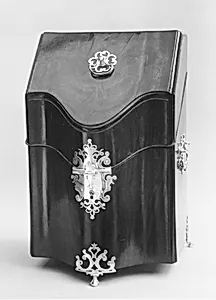
Knife Box
Medium
Mahogany, mahogany veneer, white pine, tulip poplar
Dimensions
13 1/4 x 8 x 7 3/4 in. (33.7 x 20.3 x 19.7 cm)
Classification
Knife box
Culture
American
Department
The American Wing
Museum
Metropolitan Museum of Art, New York, NY
Credit
Morris K. Jesup Fund, 1954
Accession Number
54.24.3
Rights
Public Domain
Art Historical Context
Nestled in The Metropolitan Museum of Art's American Wing, this *Knife Box* (1765–95), crafted Swiss-born cabinetmakers Lewis Fueter and his son Daniel Fueter Jr exemplifies the refined woodworking of colonial New York. Active in the city during the late 18th century, Fueters were renowned for their high-quality furniture and silverwork, blending European techniques with American ingenuity. Knife boxes like this one were essential household items, designed to store table knives securely on sideboards or buffets, reflecting the growing sophistication of American dining customs amid post-Revolutionary prosperity. Fashioned from luxurious mahogany—a premium imported wood symbolizing wealth—with mahogany veneer for decorative flair, the box also incorporates practical secondary woods like white pine and tulip poplar. At 13¼ x 8 x 7¾ inches, its compact form highlights masterful joinery and veneering techniques, where thin wood slices were applied to create elegant surfaces. This construction not only ensured durability but also showcased the cabinetmaker's skill in achieving a polished, neoclassical aesthetic influenced by British and Chippendale styles. Acquired through the Morris K. Jesup Fund in 1954, this piece offers a window into everyday luxury for America's emerging elite, underscoring the cultural fusion of immigrant artistry and New World ambition. Visitors will appreciate its subtle elegance, a testament to the unsung heroes of early American decorative arts.
About the Artist
Lewis Fueter|Daniel Fueter Jr. ( |American) · 1766 |1783 –1775 |1806
active ca. 1769–75|active ca. 1786–1806