
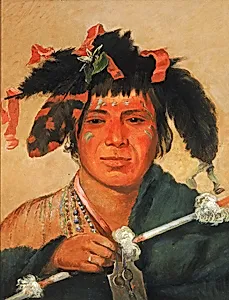
Ko-mán-i-kin-o-haw, Little Whale, a Brave
1831
Medium
Painting
Classification
Painting
Department
Smithsonian Collection
Museum
Smithsonian American Art Museum
Credit
Smithsonian American Art Museum, Gift of Mrs. Joseph Harrison, Jr.
Accession Number
1985.66.221
Rights
Public Domain
Tags
About this artwork
Late in the autumn of 1830, George Catlin visited Washington, D.C., where he painted members of a delegation of Menominees from Michigan Territory. He described Little Whale as “a brave with his medicine-wand, his looking-glass, and scissors.” (Catlin, 1848 Catalogue, Catlin’s Indian Gallery, SAAM online exhibition)
Art Historical Context
In the autumn of 1830, artist George Catlin captured the dignified likeness of Ko-má n-i-kin-o-haw, known as Little Whale, a brave from the Menominee tribe of Michigan Territory. This 1831 oil painting emerged from Catlin's encounter with a Native American delegation visiting Washington, D.C., growing U.S. expansion westward. Catlin, a pioneering Romantic artist and ethnographer, devoted his career to portraying Indigenous peoples in their traditional regalia, creating an invaluable visual record before cultural disruptions intensified. Little Whale stands proudly with his medicine-wand—a sacred staff symbolizing spiritual power—alongside a looking-glass and scissors, personal items Catlin noted as emblems of his status and bravery. These details highlight Menominee customs and the fusion of tradition with encountered trade goods, offering a window into 19th-century Native life during tense treaty negotiations. Housed in the Smithsonian American Art Museum, this portrait exemplifies Catlin's realistic style, blending portraiture with documentary intent. It preserves not just a face, but a vanishing world, inviting visitors to reflect on America's complex Indigenous heritage.
About the Artist
George Catlin · 1796–1872
George Catlin (1796–1872), born in Wilkes-Barre, Pennsylvania, to Putnam Catlin and Polly Sutton—who had been captured by Native Americans during the 1778 Battle of Wyoming—initially pursued a legal career. Trained at Litchfield Law School, he was admitted to the bar in 1819 but abandoned law after two years to study art in Philadelphia in 1823. Self-taught as a portraitist, Catlin quickly gained ...