
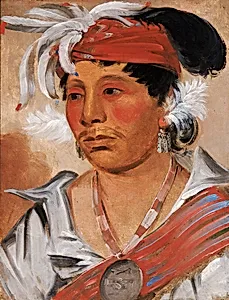
String, a Renowned Warrior
1831
Medium
Painting
Classification
Painting
Department
Smithsonian Collection
Museum
Smithsonian American Art Museum
Credit
Smithsonian American Art Museum, Gift of Mrs. Joseph Harrison, Jr.
Accession Number
1985.66.268
Rights
Public Domain
Tags
About this artwork
The Seneca warrior String came to Washington in early 1831, accompanying a delegation of his tribesmen who were there to negotiate a treaty for the sale of their lands south of Lake Erie to the United States. George Catlin probably painted String and other members of the tribe in the capital that year. The artist described the Senecas as “one of the most numerous and effective tribes, constituting the compact called the ‘Six Nations’ . . . a confederacy formed by six tribes, who joined in a leag...
Art Historical Context
In 1831, George Catlin captured the dignified likeness of String, a renowned Seneca warrior during a pivotal moment in Native American history. String traveled to Washington, D.C., with a delegation from his tribe to negotiate the of their lands south of Lake Erie to the United States—a treaty that reflected the mounting pressures of westward expansion on Indigenous territories. Catlin, a 19th-century artist dedicated to portraying Native Americans, likely painted String and his fellow tribesmen amid these tense discussions, creating an intimate record of their presence in the nation's capital. As part of the powerful Six Nations confederacy—also known as the Iroquois League—the Seneca were celebrated by Catlin for their unity and resilience. He described them as "one of the most numerous and effective tribes," whose alliance helped them withstand both rival nations and encroaching settlers. This oil portrait exemplifies Catlin's realistic style, emphasizing the subject's noble bearing and cultural pride, and serves as a vital historical document preserving Seneca identity during an era of rapid change. Today, housed in the Smithsonian American Art Museum, *String, a Renowned Warrior* invites visitors to reflect on the human stories behind treaties and treaties' consequences, highlighting Catlin's mission to honor Native leaders before their worlds were forever altered.
About the Artist
George Catlin · 1796–1872
George Catlin (1796–1872), born in Wilkes-Barre, Pennsylvania, to Putnam Catlin and Polly Sutton—who had been captured by Native Americans during the 1778 Battle of Wyoming—initially pursued a legal career. Trained at Litchfield Law School, he was admitted to the bar in 1819 but abandoned law after two years to study art in Philadelphia in 1823. Self-taught as a portraitist, Catlin quickly gained ...