
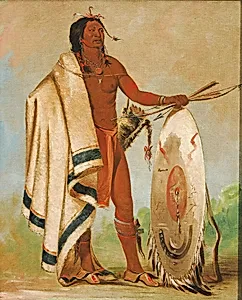
Kotz-a-tó-ah, Smoked Shield, a Distinguished Warrior
1834
Medium
Painting
Classification
Painting
Department
Smithsonian Collection
Museum
Smithsonian American Art Museum
Credit
Smithsonian American Art Museum, Gift of Mrs. Joseph Harrison, Jr.
Accession Number
1985.66.63
Rights
Public Domain
Tags
About this artwork
George Catlin described Smoked Shield as “another of the extraordinary men of this tribe [Kiowa], near seven feet in stature, and distinguished, not only as one of the greatest warriors, but the swiftest on foot, in the nation. This man, it is said, runs down a buffalo on foot, and slays it with his knife or his lance, as he runs by its side!” Smoked Shield’s most notable accessory is his shield, made of the heaviest part of a buffalo hide and smoked over a campfire to make it even tougher. Smok...
Art Historical Context
George Catlin's 1834 portrait *Kotz-a-tó-ah, Smoked Shield, a Warrior* captures the imposing presence of a Kiowa leader, whom the artist described as nearly seven feet tall—one of the tribe's greatest warriors and theest runner. Catlin painted this during his ambitious travels across the American Plains in the 183s, documenting Native American life through hundreds of portraits before rapid cultural changes from European. As a pioneer of ethnographic art, Catlin's realistic oil paintings preserved vanishing traditions, blending portraiture with anthropological insight. Smoked Shield's namesake accessory, crafted from the thickest buffalo hide and hardened by campfire smoke, symbolizes his prowess as a hunter and fighter. Legend has it he could chase down a buffalo on foot, slaying it mid-stride with knife or lance. Notably, he's draped in a trade blanket rather than traditional hides, hinting at the era's buffalo depletion from over-hunting, a poignant marker of encroaching environmental and cultural pressures on Plains tribes. This Smithsonian treasure offers a window into Kiowa strength and the fleeting world Catlin chronicled, reminding us of resilience amid transformation.
About the Artist
George Catlin · 1796–1872
George Catlin (1796–1872), born in Wilkes-Barre, Pennsylvania, to Putnam Catlin and Polly Sutton—who had been captured by Native Americans during the 1778 Battle of Wyoming—initially pursued a legal career. Trained at Litchfield Law School, he was admitted to the bar in 1819 but abandoned law after two years to study art in Philadelphia in 1823. Self-taught as a portraitist, Catlin quickly gained ...