
Kylix (Drinking Cup)
about 460 BCE
Medium
terracotta, red-figure
Dimensions
14.2 × 45 × 37 cm (5 5/8 × 17 3/4 × 14 1/4 in.)
Classification
drinking vessel
Department
Arts of Greece, Rome, and Byzantium
Museum
Art Institute of Chicago
Accession Number
185
Rights
Public Domain
About this artwork
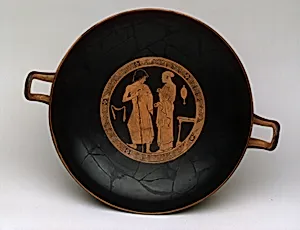
This is an example of the most popular type of wine cup, the kylix. Rising from a round foot and a thin stem, the cup flares out to a wide bowl with two handles on opposite sides. The interior of a kylix typically has a painted scene within a tondo, or circular frame, which would have been gradually revealed to the drinker as the wine was consumed. Here a youth stands before a woman.
Art Historical Context
This elegant terracotta kylix, created around 460 BCE by the Penthesilea Painter, exemplifies the refined artistry of Classical Athens. As a drinking cup designed for use in symposia—lively gatherings where men debated philosophy, recited poetry, and enjoyed wine—this vessel reflects the central role of ceramics in ancient Greek social and ritual life. Its impressive scale, spanning 45 centimeters across, suggests it may have served both practical and display purposes, highlighting the wealth and cultural sophistication of its original owners. The Penthesilea Painter belonged to the red-figure tradition, a revolutionary technique that emerged in Athens around 530 BCE. By painting background areas black and leaving figures in the natural red clay, artists could render anatomy, drapery, and expressions with far greater detail and naturalism than earlier black-figure methods allowed. This approach flourished during the height of Athenian democracy and artistic achievement, coinciding with the construction of the Parthenon. Today housed in the Art Institute of Chicago’s collection of Greek, Roman, and Byzantine art, the kylix invites us to appreciate how everyday objects carried profound cultural meaning, connecting us directly to the visual world of ancient Greece.