
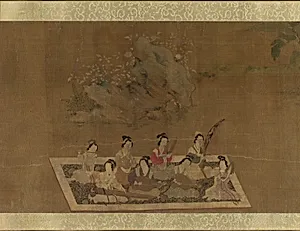
明 佚名 蘇蕙璇璣圖 卷|Lady Su Hui and Her Verse Puzzle
16th century
Medium
Handscroll; ink and color on silk
Dimensions
Image: 10 1/16 in. x 10 ft. 2 3/4 in. (25.6 x 311.8 cm)
Classification
Paintings
Culture & Period
China · Ming dynasty (1368–1644)
Department
Asian Art
Museum
Metropolitan Museum of Art, New York, NY
Credit
Gift of George D. Pratt, 1933
Accession Number
33.167
Rights
Public Domain
Tags
Art Historical Context
This exquisite handscroll, *Lady Su Hui and Her Verse Puzzle* (蘇蕙璇璣圖卷), painted by the renowned Ming dynasty artist Qiu Ying in the th century, captures a legendary moment from Chinese literary history. Qiu Ying, a master of Wu School, is celebrated for his intricate compositions, vibrant colors, and precise ink lines on silk, blending Song dynasty elegance with Ming dynamism. Here, ink and subtle colors bring to life elegant women—some playing musical instruments like lutes and flutes—gathered around the scholar Lady Su Hui, evoking a scene of refined cultural exchange. Lady Su Hui (ca. 4th century CE), a poet from the Eastern Jin dynasty, is immortalized for her extraordinary *Xuanji Tu* (Rotor Diagram), a palindrome poem of 840 interlocking characters arranged in a circular grid. Readable forward, backward, and in multiple directions, it expressed her longing for her exiled husband, showcasing unparalleled literary ingenuity. This painting reveres her as a symbol of female intellect and artistic devotion, a rare tribute in traditional Chinese art. As a handscroll (25.6 x 311.8 cm), the work unfolds sequentially, inviting viewers to immerse themselves in its narrative flow—a format ideal for private contemplation among literati. Donated to the Metropolitan Museum of Art in 1933, it exemplifies Ming painting's fusion of history, poetry, and visual poetry, highlighting women's roles in China's cultural heritage.